
VIMS EHSVIMS EHS

Confined space entry — tanks, manholes and silos: gas testing, isolation, standby person and rescue

A confined space is a tank, sewer, manhole, silo, chamber or equipment interior with restricted entry and exit, not designed for continuous work, where oxygen deficiency, toxic or flammable gases or engulfment may occur. Polish rules classify such work as particularly hazardous, requiring written instructions, a standby person and direct supervision.

This guide answers the questions safety teams, maintenance managers and contractors search for: what counts as a confined space, in what order to test gases, what oxygen level is safe, what the standby person may do, whether a filter mask is enough and which documents are needed before entry. We separate legal duties from standards and industry practice.

  • Confined spaces
  • Particularly hazardous work
  • Gas testing
  • Standby person
  • LOTO
  • Permit to work

Published: 2026-11-12 · Updated: 2026-11-12 · 12 min read · Varilo deployment team

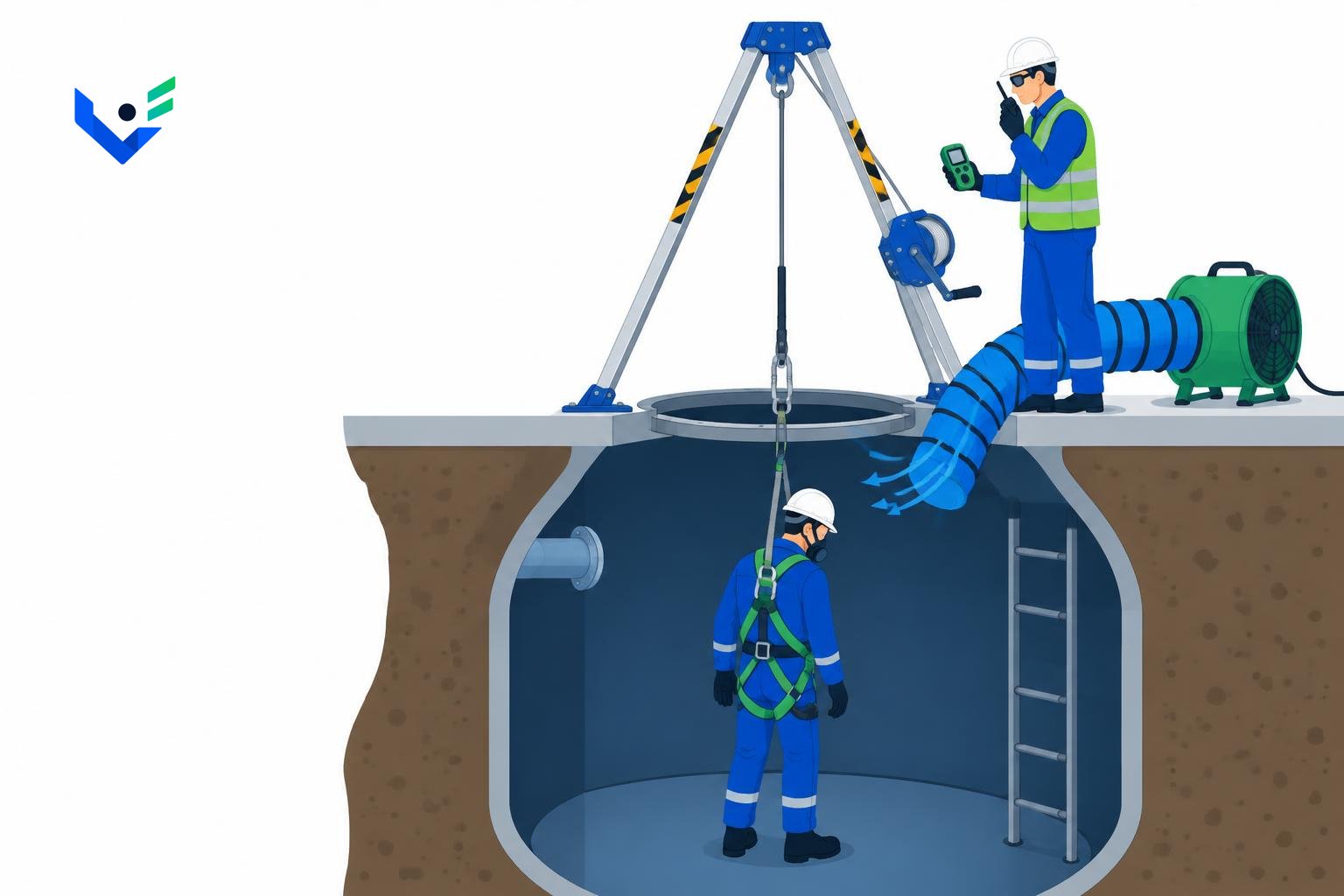
Worker in a harness on a rescue tripod line inside an underground tank, standby person at the hatch with a gas detector and radio, ventilation fan — VIMS EHS illustration

1. What is a confined space and which rules apply?

Short answer: Polish law has no single definition. The general OSH regulation, in its part on particularly hazardous work (§ 80–82), lists work in tanks, sewers, equipment interiors and other hazardous spaces. In practice this includes manholes, valve and cable chambers, settling tanks, silos, bulk hoppers, road tankers and ship holds.

For such work the employer sets detailed safety requirements and provides direct supervision by a designated person, protective measures and an instruction covering named roles, task sequence and requirements (article 225 of the Labour Code and § 81). The regulation also requires at least two people to ensure a standby.

When several employers work in one place — for example a tank-cleaning contractor — the coordination duty of article 208 applies; see the guide on subcontractor safety supervision. Sector rules (sewerage, gas, agriculture, welding in tanks) may add requirements; check paragraph numbers in the consolidated text.
2. What hazards occur in tanks and manholes?

Short answer: the most dangerous ones cannot be seen or smelt. Oxygen deficiency arises from rusting steel, fermentation or displacement by nitrogen or carbon dioxide. Hydrogen sulphide (H₂S) from decaying sewage quickly paralyses the sense of smell. Carbon monoxide (CO) comes from engines and combustion. Methane and solvent vapours create explosive atmospheres.

Physical hazards add to this: engulfment in bulk material in silos, agitators or pumps starting up, liquid or steam entering from pipelines, heat, falls on descent and difficult evacuation through a narrow hatch. Each must be covered by a pre-task risk assessment, not just the general job card.

3. In what order should gases be tested and what thresholds apply?

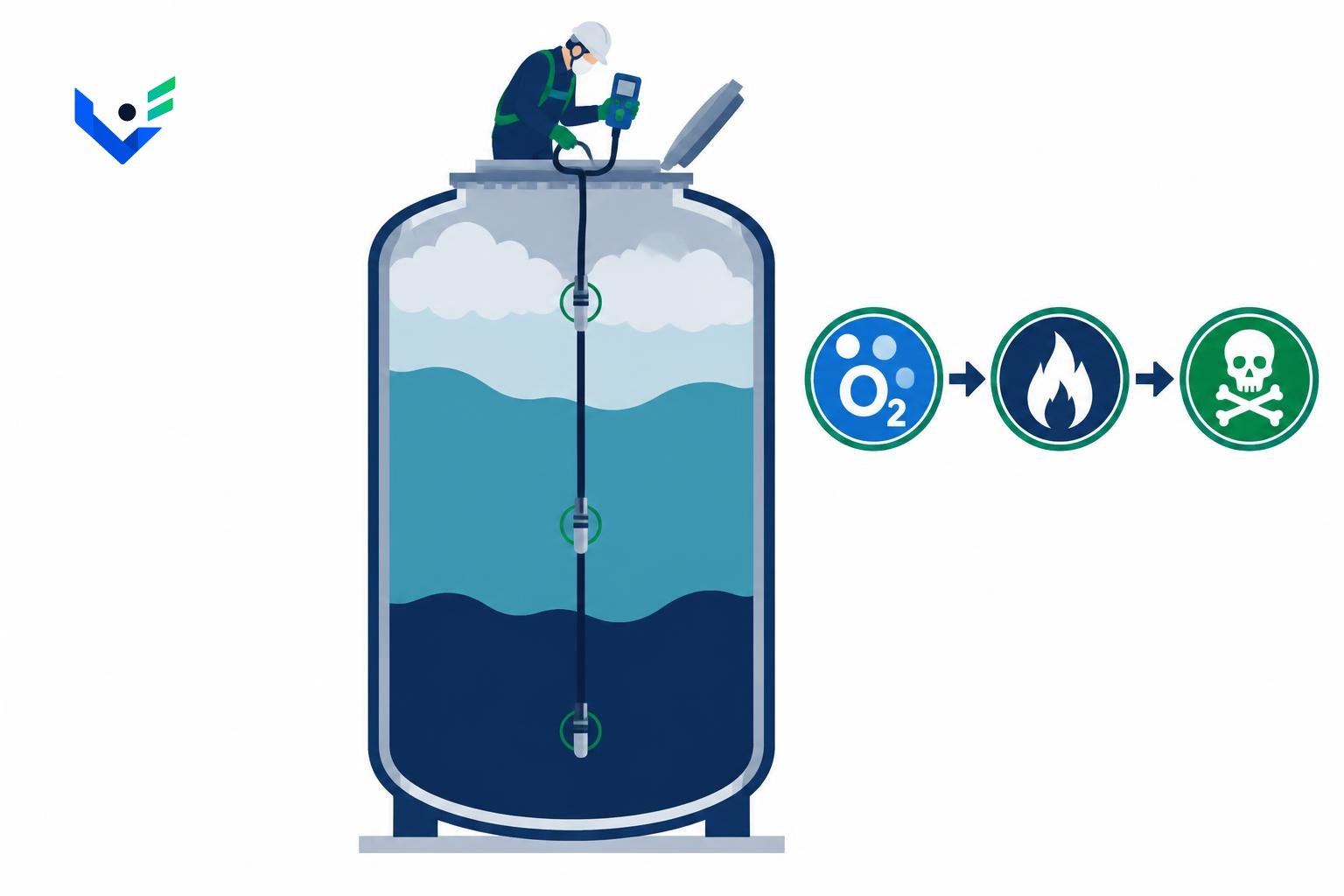
Short answer: oxygen → flammables → toxics. Oxygen comes first because catalytic flammable-gas sensors under-read in oxygen-deficient air. Test from outside with a pumped probe before fully opening the hatch and before each entry, then continuously with a detector worn by the entrant.

Gases stratify, so sample at several levels: near the top (methane is lighter than air), the middle (CO is close to air density) and the bottom (H₂S, CO₂ and solvent vapours are heavier). Allow the probe time to draw the sample — usually a few seconds per metre of hose per the manufacturer's instructions.

Polish rules set no entry thresholds; the site procedure does. Common values are oxygen 19.5–23.5% vol. (OSHA-based practice; some Polish procedures use 19–23%), flammables below 10% LEL and toxics below occupational exposure limits — for H₂S 7 mg/m³ (about 5 ppm) and for CO 23 mg/m³ (about 20 ppm), plus short-term limits. Check current values in the regulation. The detector needs valid calibration and a bump test before use.

Tank cross-section with a sampling probe at three levels and gas layers, plus testing order: oxygen, flammables, toxics — VIMS EHS illustration
Illustrative image: testing at several levels in the order oxygen, flammables, toxics.

4. How to isolate a tank from media and energy

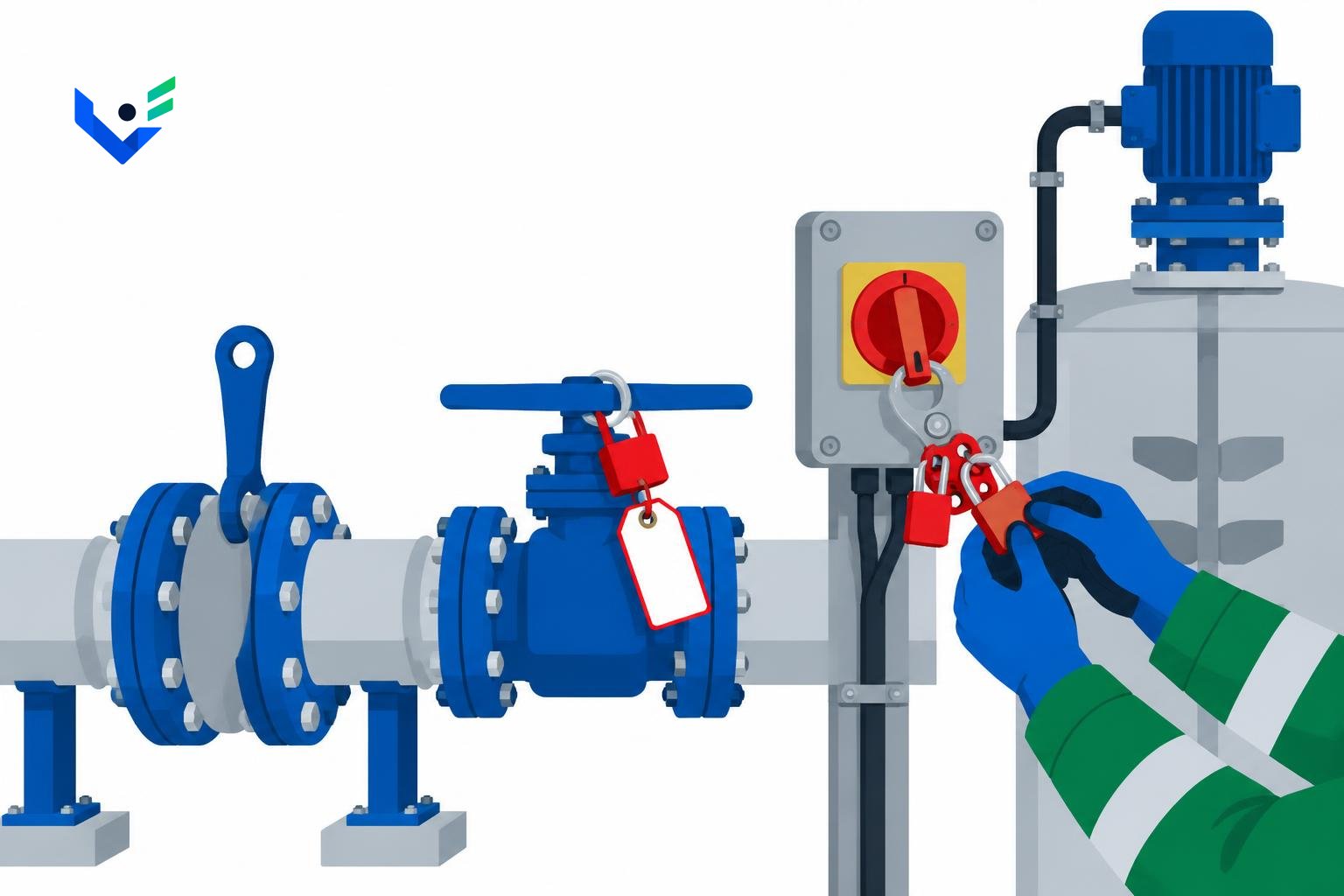
Short answer: physically, not just by closing a valve. Lines carrying liquids, gases or steam are isolated with a blind flange (spade) or by removing a spool piece; a closed valve can leak or be opened by mistake. Agitators, pumps and conveyors are switched off and locked out under the LOTO procedure — each entrant applies their own padlock.

The tank is then emptied, flushed or purged and ventilated mechanically, usually by forced supply air. Never 'improve' the atmosphere with pure oxygen — enrichment sharply increases flammability of clothing and materials. In potentially explosive atmospheres fans and lights need a suitable protection level and power tools reduced voltage.

Isolation before tank entry: spade between pipeline flanges, valve locked with a tagged padlock, agitator isolator switched off with padlocks — VIMS EHS illustration
Illustrative image: blanking the pipeline and locking out energy before entry.

5. What does the standby person do — and may they go in?

Short answer: the standby person stays outside at the hatch at all times, keeps visual, voice or radio contact, watches detector readings, keeps others away and orders evacuation when needed. They do no other tasks meanwhile.

The standby person must not enter to rescue without raising the alarm and wearing independent breathing apparatus. NIOSH analyses show that about 60% of confined-space fatalities were would-be rescuers. Rescue starts from outside: winching the casualty out by the line clipped to the harness, calling emergency services and ventilating.

The entrant therefore wears a full body harness with a line led outside, and a tripod or other anchor with a rescue device stands over the hatch (EN 795, EN 1496). A rescue plan with named people and equipment must be ready before entry — fire brigade response usually takes longer than survival time without oxygen.

6. Is a filter mask enough to enter a tank?

Short answer: no, if oxygen may be lacking or the concentration is unknown or high. Filtering devices clean ambient air but do not supply oxygen. Confined spaces call for isolating equipment: self-contained or airline breathing apparatus with a clean air source.

Filters also have limited service life and are gas-specific. Respiratory protection should follow the risk assessment and measurements; see the guide on PPE and workwear for records and inspections.

7. Which documents are needed before entry?

Short answer: a written permit to work (PTW) or written instruction for particularly hazardous work stating location, scope, people (issuer, supervisor, entrants, standby), isolation, test results, PPE, rescue equipment, communication and validity. Add a job briefing, current medical clearance and training of participants.

The permit is closed after the work — once everyone is out, tools are removed and locks are taken off in the agreed order. Record test results with time and detector number; they are key evidence in any incident analysis.

8. How VIMS supports confined space work

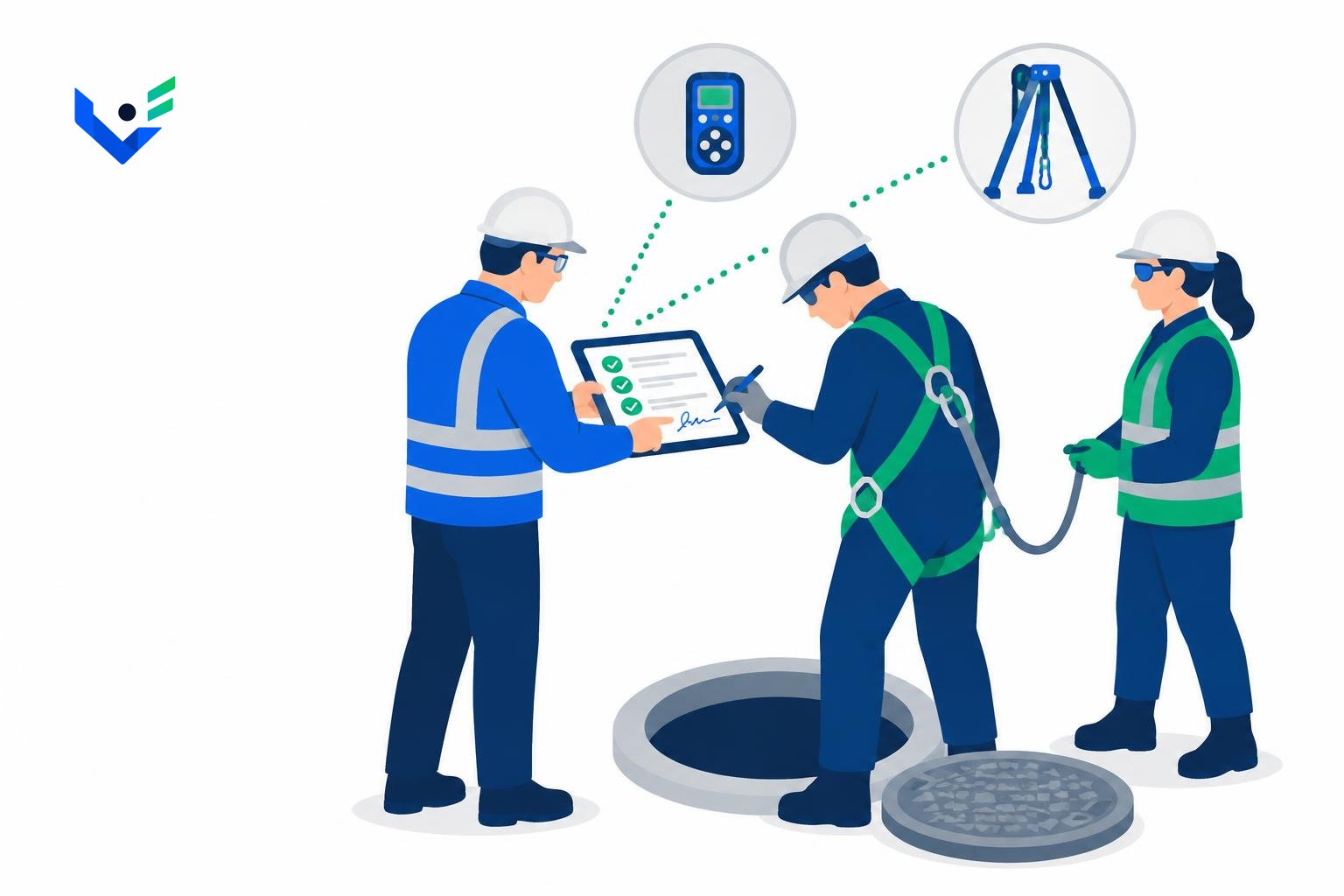
The permit to work module guides the isolation checklist, test results, assignment of entrants and standby and signatures at start and close-out. Last minute risk assessment (LMRA) lets the team confirm conditions right before entry.

Equipment registers track detector calibration and inspections of tripods, harnesses and breathing apparatus. The Lone Worker module can add communication but does not replace a physical standby person at the hatch. The diagram below illustrates the process and is not a screenshot.

Briefing at a manhole: permit issuer with a tablet checklist and signature, entrant in a harness and standby person, gas detector and tripod icons — VIMS EHS illustration
Illustrative image: a permit with test results and signatures before work starts. Not an app screenshot.

Gases in confined spaces — behaviour and indicative thresholds

Polish occupational exposure limits (NDS); entry thresholds are set by the site procedure.

GasDensity vs airWhere it collectsIndicative thresholdEffects
Oxygen (O₂)—Deficiency throughout19.5–23.5% vol.Below 16% impairment, below 10% unconsciousness
Hydrogen sulphide (H₂S)Heavier (approx. 1.19)At the bottom, in sludgeNDS 7 mg/m³ (approx. 5 ppm)Loss of smell, unconsciousness, death
Carbon monoxide (CO)Similar (approx. 0.97)ThroughoutNDS 23 mg/m³ (approx. 20 ppm)Headache, dizziness, unconsciousness
Methane (CH₄)Lighter (approx. 0.55)Under the roofBelow 10% LELExplosion; displaces oxygen
Carbon dioxide (CO₂)Heavier (approx. 1.5)At the bottomNDS 9000 mg/m³Breathlessness, unconsciousness

Confined space pre-entry checklist

  • A written permit with named roles and validity has been issued.
  • Lines are blanked or disconnected and drives locked out with each entrant's padlock.
  • The tank is emptied, flushed and mechanically ventilated — never with oxygen.
  • Tests were done in the order oxygen, flammables, toxics, at several levels.
  • The detector is calibrated and bump-tested; the entrant wears it during work.
  • The standby person is at the hatch with communication and no other tasks.
  • The entrant wears a harness with a line led outside and a tripod with a rescue device is in place.
  • Isolating breathing apparatus is available if oxygen may be lacking.
  • The rescue plan is briefed and the emergency number and helpers are known.
  • Participants have a briefing, current medical clearance and training.

Frequently asked questions about confined space entry

What is a confined space under Polish OSH rules?

There is no single definition. The general OSH regulation classifies work in tanks, sewers, equipment interiors and other hazardous spaces as particularly hazardous work.

In what order are gases tested before entering a manhole?

Oxygen first, then flammables, then toxics, at several heights — top, middle and bottom.

What oxygen level is safe?

19.5–23.5% vol. is widely used. Polish rules set no threshold, so the site procedure defines it.

May the standby person enter to rescue a worker?

Not without raising the alarm and wearing independent breathing apparatus. Rescue starts by winching the casualty out from outside.

Is a filter mask enough inside a tank?

No, if oxygen may be lacking or the concentration is unknown. Use isolating equipment — self-contained or airline apparatus.

How many people must carry out tank work?

At least two, to ensure a standby, under direct supervision of a designated person.

Permits, gas tests and rescue equipment in one process

See how VIMS links permits to work, gas test results, LOTO isolation and inspections of rescue equipment.