

VIMS EHSVIMS EHS

Food safety management — hygiene inspections, audits and evidenced actions

In a food plant most information is created on the floor: during a hygiene walk, a GHP/GMP zone check, a cleaning and disinfection verification. Its value depends on whether it enters a process or a notebook. VIMS EHS turns observations into records with an owner, a deadline and evidence — supporting HACCP and the requirements of IFS Food, BRCGS or FSSC 22000 operationally.

  • GHP/GMP hygiene walks
  • Prerequisite programmes (PRP)
  • Internal and supplier audits
  • Nonconformities and CAPA
  • Hygiene training
  • Cleaning chemicals and SDS
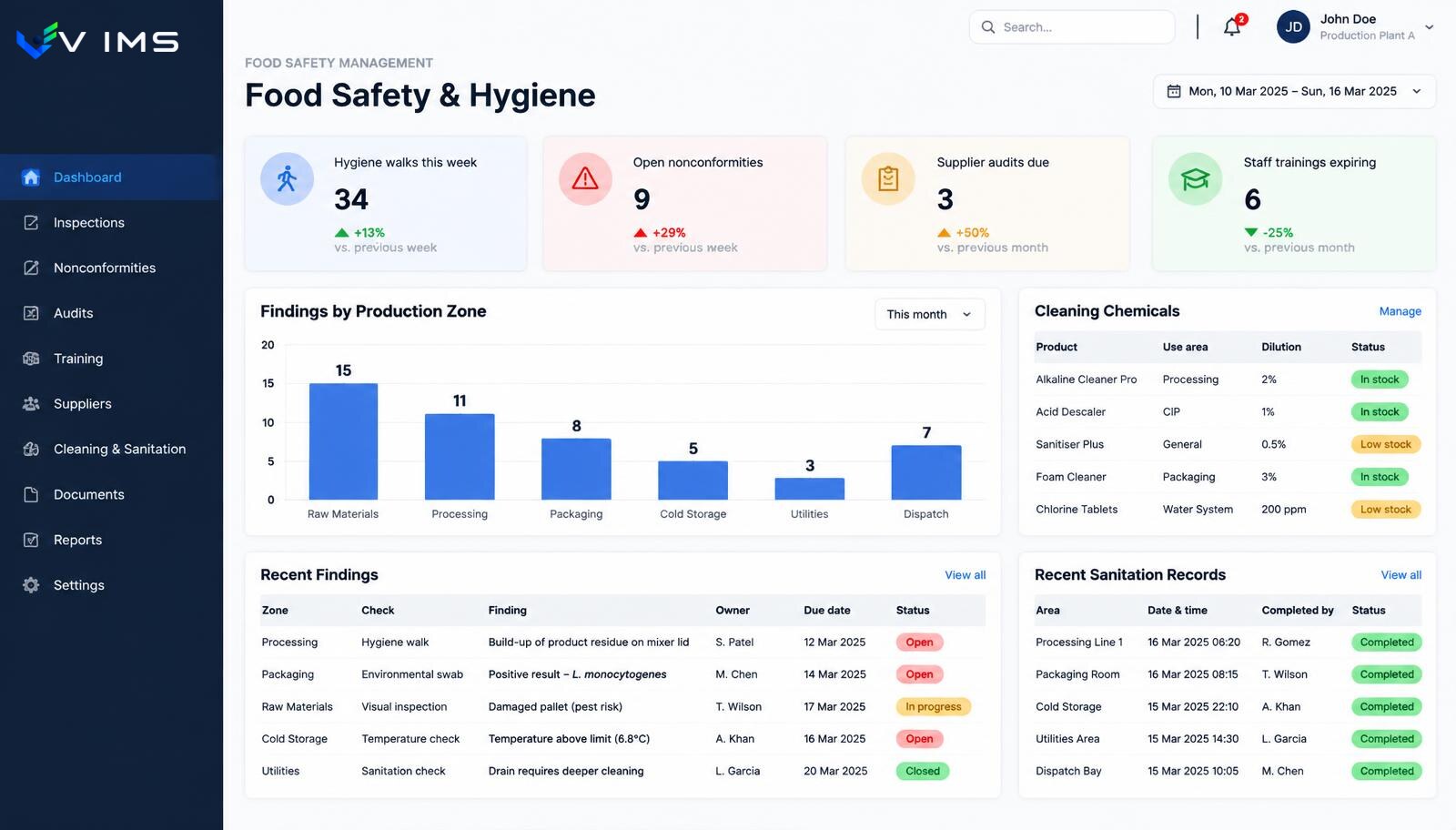
VIMS EHS — food safety dashboard with hygiene walks this week, open nonconformities, supplier audits due, findings by production zone and a register of cleaning agents and chemical substances

Why food plants have too many records and too few conclusions

A food plant produces an enormous number of records: post-cleaning checklists, temperature sheets, zone walks, pest control checks, internal audits, supplier assessments. Formally everything exists. In practice most of it ends in a binder that nobody mines for conclusions between one customer audit and the next.

The reason is mundane. Paper records cannot be aggregated. You cannot quickly answer which zone accumulates repeat findings, or whether the action introduced in March actually reduced remarks in the following quarter.

The second problem is the gap between observation and action. A remark on a checklist has to be copied into a separate action register — an extra step that is easy to skip during shift work. As a result, some observations never become tasks.

Floor data as the start of a process, not an archive

In VIMS a hygiene walk is performed on a phone in the zone it concerns. Any observation can become a nonconformity immediately, with an owner, a deadline and a photo as evidence. There is no retyping step.

Because findings are stored in fixed categories and attached to zones, reports build themselves. A chart of findings by zone shows where the problem really concentrates — usually not where intuition suggests.

Internal audits and supplier audits use the same action flow, so all open commitments — against your own requirements and your customers' — are visible in one place regardless of where the finding came from.

HACCP, prerequisite programmes and IFS, BRCGS, FSSC 22000 — where software helps

HACCP relies on hazard analysis and critical control points (CCP), but its effectiveness depends on prerequisite programmes (PRP): good hygiene and manufacturing practice (GHP/GMP), cleaning and disinfection, pest control, personal hygiene, infrastructure maintenance and allergen management. These areas generate most audit findings.

IFS Food, BRCGS Food Safety and FSSC 22000 (based on ISO 22000) add requirements on food safety culture, traceability, food defense and food fraud vulnerability, supplier approval and effective corrective actions. The common audit question: does each finding have an owner, a deadline and verification evidence?

VIMS EHS is not a ready HACCP plan or certification module. It runs the operational layer: GHP/GMP inspections by zone, internal and supplier audits, the nonconformity register, CAPA, hygiene training and a cleaning chemical register with SDS.

What a food safety team runs in one environment

Hygiene walks and zone checks

Walk templates performed in the zone, with control points and the option to raise a nonconformity with a photo on the spot.

Internal and supplier audits

Plan, scope, findings and actions in one record. A supplier finding becomes a task on your side instead of a note in an email.

Nonconformities by zone and process

Context captured at registration allows recurrence analysis by zone, line, shift or product category.

Corrective actions with verification

For every finding it is visible who is responsible, by when, and at which point effectiveness will be checked.

Cleaning chemicals, process substances and SDS

A register of preparations with safety data sheets and the areas where each one is used.

Personnel qualifications and health checks

Hygiene training, required qualifications and examination dates shown as upcoming deadlines rather than a list to check by hand.

From a zone walk to audit evidence

The same flow handles a walk remark, an internal audit finding and a supplier audit result.

  1. 1Hygiene walk or zone check
  2. 2Observation stored in a category
  3. 3Nonconformity with owner and date
  4. 4Root cause for significant cases
  5. 5Corrective action and evidence
  6. 6Effectiveness verification
  7. 7Findings report by zone
  8. 8Documentation ready for audit

Modules in this solution

Each module works on its own, yet together they form the single data flow described above.

Registers and inspections

A plant runs a dozen parallel registers: cranes, pressure vessels, forklifts, extinguishers, hydrants, electrical installations, ladders, hoists, gates. Each has its own cycle and its own owner. This module brings them into one register with one calendar.

Explore the VIMS EHS module: Registers and inspections with reminders

Customer audit preparation without a week of overtime

The typical scenario before a second-party audit looks the same in most plants: two weeks of gathering records, collecting signatures and hunting for evidence of actions completed a year ago. The work is real but adds nothing to product safety.

When records are created in the system at the moment the work happens, preparation changes character. Instead of assembling, you review what already exists: open actions, walk history by zone, previous audit findings with closure evidence attached.

One detail deserves attention because auditors check it eagerly: whether an action had a verification moment. A bare 'completed' without confirmed effectiveness is the most common opening for questions.

Linking personnel, hygiene and process

A large share of hygiene findings does not come from missing procedures but from staffing: a new person on shift, an employee moved between zones, holiday cover with less experience in that area.

When personnel data and findings live in one system, that pattern becomes visible. You can check whether remarks cluster on particular shifts, or whether people moved into high-care zones hold the full set of required training and health checks.

This is not about judging people — it is diagnostics of the onboarding process. If findings rise after every rotation, the problem is how people are introduced to the zone.

Questions from QA and food safety teams

What are prerequisite programmes (PRP) and how are they documented?

PRPs are the basic hygiene conditions: GHP, GMP, cleaning and disinfection, pest control, personal hygiene and infrastructure maintenance. They are documented through inspection and walk records — in the system each record can raise a nonconformity with a photo and a corrective action. See safety walks and inspections.

How do we prepare for an IFS or BRCGS audit?

Auditors mainly check whether findings from the previous audit and internal audits have a cause, an action and evidence of effective closure. When records are created as work happens, preparation means reviewing open actions rather than assembling binders.

How should cleaning and disinfection chemicals be registered with safety data sheets?

Every chemical used in the plant should have a current safety data sheet (SDS) and be assigned to the zones where it is used. The VIMS EHS chemical register stores SDS and gives workers a short sheet via QR code — see the chemical register.

Does VIMS include a ready HACCP, IFS or BRC module?

We do not offer a certification module. VIMS supports the processes such schemes require operationally: walks, nonconformities, root cause, actions, verification, registers and personnel qualifications.

Can walks be done without connectivity in cold storage?

This depends on plant infrastructure. We agree the scope of work under limited connectivity individually and do not promise behaviour we have not confirmed on a specific configuration.

Does the system handle temperature checks and process records?

Control records are kept as inspection records with points and values. How specific records are mapped is agreed during configuration.

How are customer findings handled?

A second-party audit finding enters the same action register as an internal one, so you do not maintain two parallel lists of commitments.

Can we analyse recurring problems?

Yes, provided categories are used at registration. Reports by zone, category and period are built from live data.

Who should own the system in the plant?

Usually QA or food safety, with shift managers as action owners. Walks are performed by the people working in the zones.

Other solutions

Solution for safety teams

See

Solution for quality teams

See

Solution for audit and compliance

See

Solution for fire protection

See

See VIMS on your plant's processes

A hygiene walk, a zone nonconformity, an action and its evidence — on an example close to your production.