
VIMS EHSVIMS EHS

PPE vs work clothing and protective clothing: differences, categories, allocation tables and issue records

Personal protective equipment (PPE) is equipment worn or held by a worker to protect against health and safety risks that cannot be eliminated by other means. Work clothing and footwear mainly protect the worker's own clothes or meet technological and hygiene requirements. Protective clothing, such as flame-retardant, high-visibility or chemical-resistant garments, is PPE.

This guide answers what employers, safety officers, HR and storekeepers search for most: how work clothing differs from protective clothing, how often workwear is due, who sets the allocation table, which issue records to keep, when a laundering allowance applies and how to track category III equipment. Legal references are Polish, with the EU PPE regulation.

  • Personal protective equipment
  • PPE
  • Work clothing
  • Protective clothing
  • PPE allocation table
  • Laundering allowance

Published: 2026-11-12 · Updated: 2026-11-12 · 10 min read · Varilo deployment team

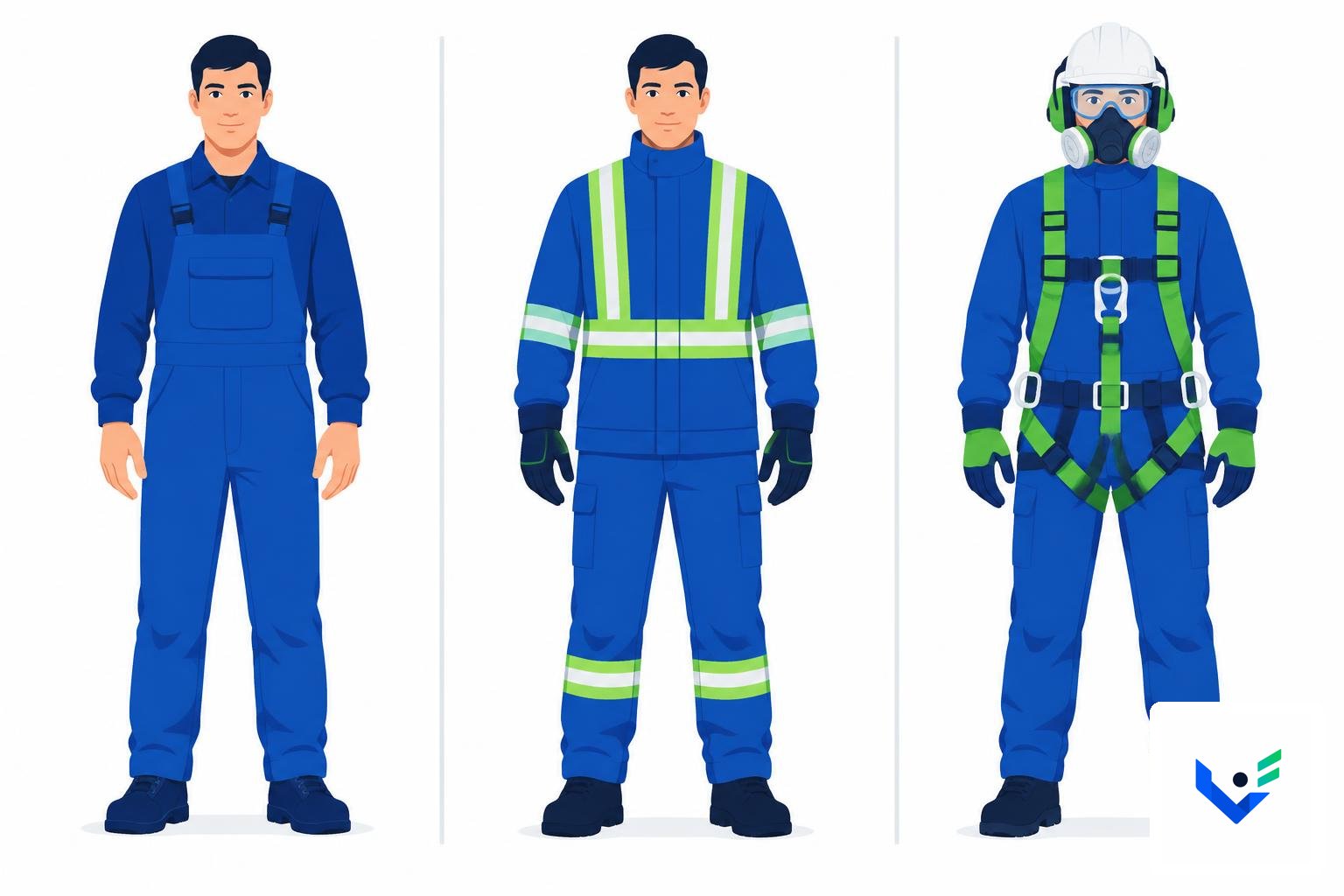
Three workers: in work overalls, in protective clothing with reflective stripes and in full PPE with helmet, respirator and harness — VIMS EHS illustration

1. How does work clothing differ from protective clothing and PPE?

Short answer: function, not appearance, decides. Work clothing and footwear are provided when the worker's own clothes could be damaged or heavily soiled, or for technological, hygiene or safety reasons (art. 237⁷ of the Polish Labour Code). PPE is provided free of charge to protect against hazards and must meet conformity assessment requirements (art. 237⁶).

Protective clothing is PPE: chemical suits, welding garments, high-visibility vests and arc-flash clothing carry CE marking, a declaration of conformity and manufacturer information. A plain company-branded overall is work clothing.

PPE is selected from the occupational risk assessment and withdrawn based on condition and manufacturer guidance; work clothing has expected service periods set by the employer. Both remain the employer's property.

2. What are the PPE categories?

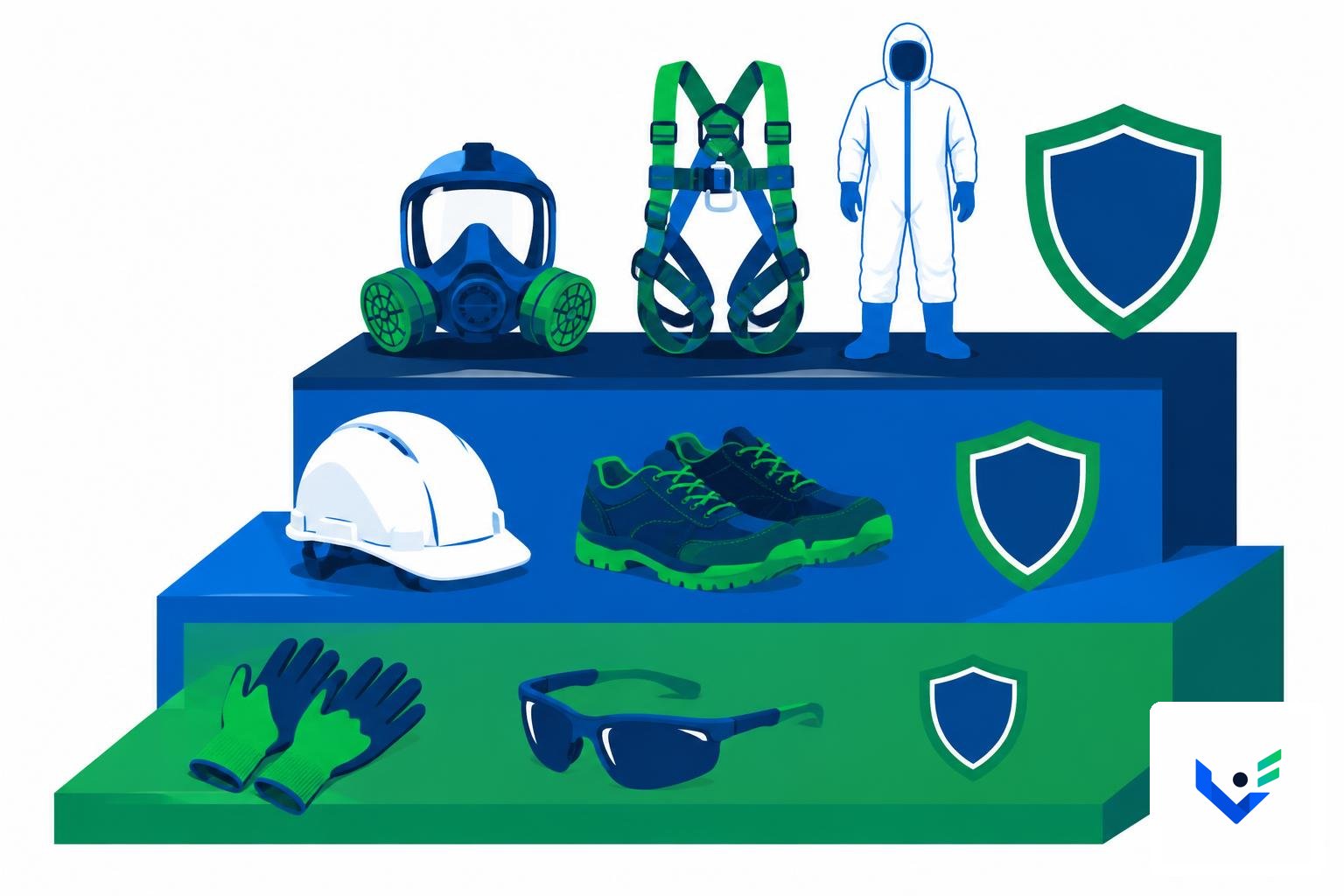
Short answer: Regulation (EU) 2016/425 sets three risk categories. Category I covers minimal risks such as superficial mechanical injury, weak cleaning agents, hot surfaces up to 50°C or sunlight. Category III covers risks that may cause very serious consequences such as death or irreversible damage to health — including hazardous substances, oxygen deficiency, biological agents, falls from height, electric shock, harmful noise and temperatures from 100°C. Category II covers everything else, such as typical safety helmets and safety footwear.

Category III items such as respiratory protection or fall arrest harnesses are best tracked individually: serial number, manufacture date, first use, inspections and withdrawal date.

On issue, the employer must inform the worker how to use the equipment (art. 237⁶ § 2); for category III this usually means hands-on training, for example respirator fit checks.

Three PPE category steps: gloves and glasses, helmet and safety shoes, respirator, harness and chemical suit — VIMS EHS illustration
Illustrative image: the three PPE categories under Regulation (EU) 2016/425.

3. Who sets the allocation table and how often is workwear due?

Short answer: the employer, and there is no single statutory period. Under § 39 of the Polish general OSH regulation the employer determines the PPE, work clothing and footwear required at each workstation and the expected service periods of work clothing and footwear; Annex 2 sets general PPE allocation rules. Workers or their representatives are consulted (art. 237¹¹ᵃ).

The resulting allocation table lists, per job, the items due, workwear service periods and PPE replacement rules — usually “until worn” or per manufacturer guidance. It should follow the risk assessment and be reviewed when the assessment changes.

A single site-wide table or periods copied from someone else's template is a common mistake; an inspector may ask why a job has a given set of equipment.

4. Which records must the employer keep?

Short answer: no mandatory template, but the employer must be able to show that required items were provided and the worker was informed how to use them. Typically this is an individual PPE and workwear issue card: what was issued, when, size, period and signature.

Also useful: the allocation table, PPE conformity documents, a category III item register with inspections and laundering or repair records. Workers may not be allowed to work without required PPE and workwear (art. 237⁹ § 1), so issue records are among the first documents checked after an accident.

A storekeeper's notebook rarely links issues to job allocations or flags the next due date, and makes job transfers hard to handle.

Left: paper allocation cards and a crossed-out notebook; right: an employee record linked to a job and items with service periods — VIMS EHS illustration
Illustrative image: paper cards replaced by employee records linked to job allocations.

5. When does a laundering or own-clothing allowance apply?

Short answer: a laundering allowance is paid when the employer cannot launder work clothing and entrusts it to the worker; an own-clothing allowance applies at jobs where the employer permits own clothes. Laundering, maintenance, repair and decontamination remain the employer's duty, and allowances should reflect real costs.

The Labour Code prohibits entrusting workers with laundering clothing contaminated by chemical or radioactive agents or infectious biological material (art. 237⁹), and own clothing is restricted where such contamination or heavy soiling occurs.

An allowance never replaces PPE: employers cannot pay workers to buy their own helmets, goggles or protective gloves.

6. How does the VIMS PPE module organise allocations, issues and deadlines?

Short answer: by linking job allocations to employee records and recording each issue with acknowledgement. In the PPE records and issuance module the site builds an item catalogue and job allocations; when an employee in employee records has a job assigned, the storekeeper sees what is due, what was issued and when replacement is next due.

The worker confirms receipt on a tablet or phone, and VIMS records date, size, quantity and issuer, reminds about expiring service periods and tracks category III items individually with inspections in equipment registers and reviews. Issues for visitors and contractors are supported too.

On a job change the system shows the difference between allocations, and the full issue history is available in seconds for an inspection or accident investigation. You can join the testing programme via the contact page.

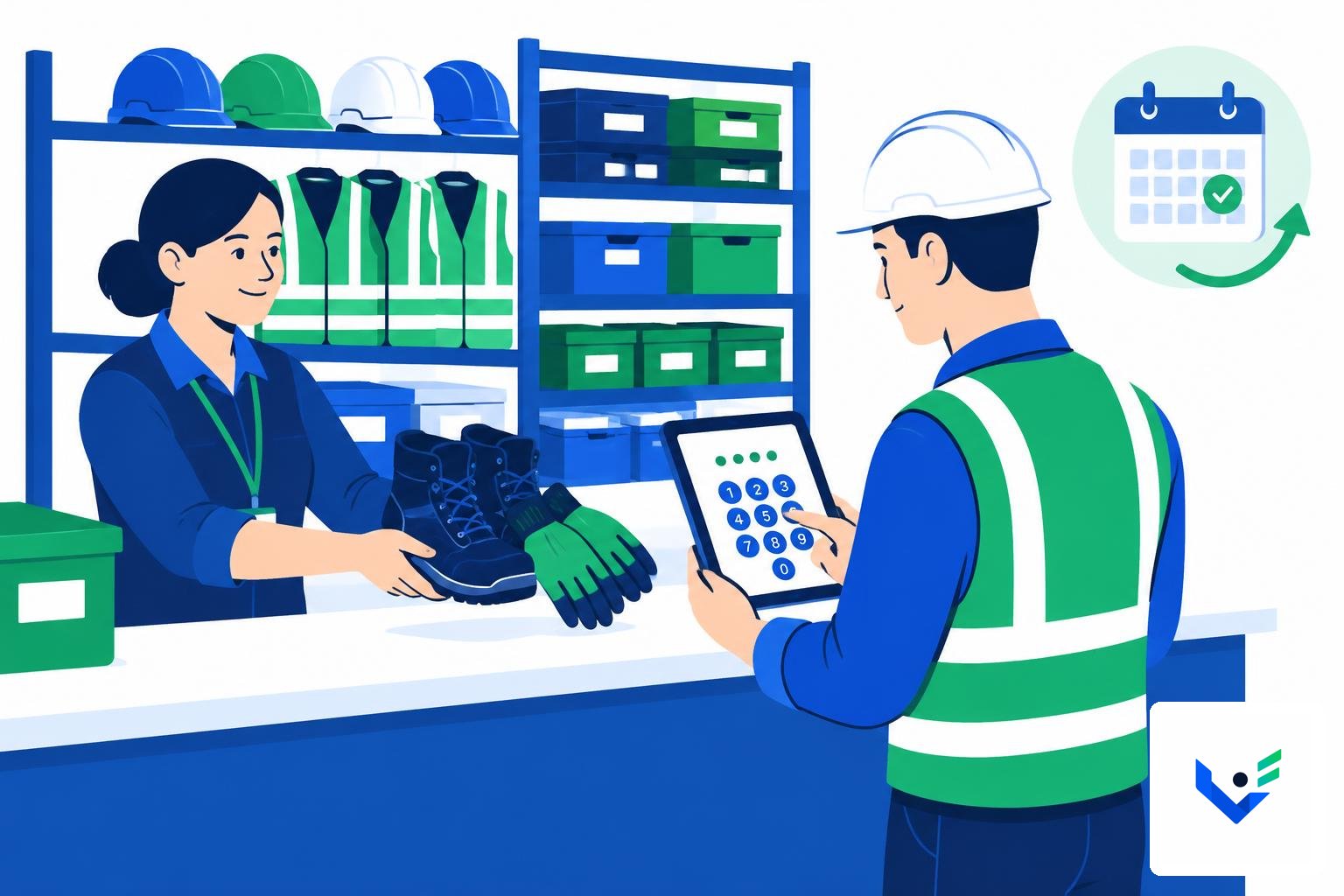
Storekeeper handing safety boots and gloves to a worker who confirms receipt with a PIN on a tablet — VIMS EHS illustration
Illustrative image: PPE issue with acknowledgement and next replacement date.

Work clothing, protective clothing and PPE compared

Basic differences. Requirements for a specific job follow from the risk assessment.

FeatureWork clothing and footwearProtective clothingOther PPE
PurposeProtect own clothes, technological and hygiene needsProtect the body from a hazardProtect head, eyes, hearing, airways, hands, against falls
Labour Code basisArt. 237⁷Art. 237⁶Art. 237⁶
Conformity assessmentNot requiredCE marking, Regulation 2016/425CE marking, Regulation 2016/425
ReplacementExpected service period set by employerCondition and manufacturer guidanceCondition, manufacturer guidance and inspections
Own-clothing allowancePossible at designated jobsNot allowedNot allowed
ExamplesWork overalls, apron, work shoesWelding suit, hi-vis vest, chemical suitHelmet, goggles, ear defenders, respirator, harness

PPE and workwear management checklist

  • An allocation table exists for each job and follows the risk assessment.
  • Workers or their representatives were consulted on it.
  • Each worker has an issue record with dates and acknowledgement.
  • PPE conformity documents and manufacturer information are available.
  • Category III items are tracked individually with inspection dates.
  • The employer launders chemically or biologically contaminated clothing.
  • Allocations are reviewed when a worker changes job.

Related modules

PPE store and issuance

PPE issuance and equipment records

A paper issue card works until the first real question: who received what, when, and whether that equipment is still fit for use. This module runs the PPE store as a register — from stock item and level, through the entitlement matrix, to a confirmed handover to a named person.

Explore the VIMS EHS module: PPE records and issuance

Employees and competence

Employees and competence — one record instead of ten separate name lists

The same people appear on the training list, in the examination schedule, in a risk assessment, on a work permit and in an accident report. If each of those lists lives its own life, sooner or later they stop agreeing. This module fixes the problem at the data level, not at the form level.

Explore the VIMS EHS module: Employee register

Occupational risk assessment

Risk assessment — a living document instead of a binder

Run risk assessment online: hazards, risk levels, control measures and reviews in one place, connected to what actually happens on site.

Explore the VIMS EHS module: Occupational risk assessment with AI

Registers and inspections

Registers and periodic inspections — deadlines tracked by the system, not by memory

A plant runs a dozen parallel registers: cranes, pressure vessels, forklifts, extinguishers, hydrants, electrical installations, ladders, hoists, gates. Each has its own cycle and its own owner. This module brings them into one register with one calendar.

Explore the VIMS EHS module: Registers and inspections with reminders

Frequently asked questions about PPE and workwear

How does work clothing differ from protective clothing?

Work clothing protects the worker's own clothes or meets technological and hygiene needs. Protective clothing protects the worker from a hazard, is PPE and carries CE marking.

How often is workwear due?

There is no single statutory period. The employer sets expected service periods in the allocation table (§ 39 of the Polish general OSH regulation).

Who sets the PPE allocation table?

The employer, after consulting workers or their representatives, based on the risk assessment and the nature of the job.

Can an allowance be paid instead of PPE?

No. PPE must be provided free of charge (art. 237⁶). Allowances apply only to laundering or own work clothing at designated jobs.

Can workers wash work clothing at home?

Only when the employer cannot launder it and pays an allowance — never for clothing contaminated by chemical, radioactive or infectious biological agents.

Which PPE is category III?

Equipment protecting against risks of death or irreversible harm, including respiratory protection, fall arrest equipment and protection against hazardous substances, electric shock and harmful noise.

How should electronic PPE issue records work?

They should link each issue to the worker, job and allocation and record date, size and acknowledgement. VIMS does this in its PPE module linked to employee records.

PPE issues linked to employee records

See how VIMS combines job allocations, acknowledged issues, replacement reminders and category III item tracking.