

VIMS EHSVIMS EHS

Subcontractor safety supervision on construction sites — document checks, Labour Code art. 208 and equipment admission

Subcontractor safety supervision on a construction site is a structured process in which the main contractor or client checks the qualifications of contractor workers, the technical condition of the equipment they bring and compliance with the site health and safety plan (BIOZ plan in Poland). Its legal basis in Poland is article 208 of the Labour Code, which requires employers working in one place to cooperate and appoint an OHS coordinator.

A construction site often hosts a dozen companies at once and crews change week to week. Written from the perspective of a site safety practitioner, this guide shows which documents to check before admitting a subcontractor, how to admit its power tools, site distribution boards, scaffolding and ladders, and why a spreadsheet stops working when staff rotation is high.

  • Contractor supervision
  • Labour Code art. 208
  • Site OHS coordinator
  • Scaffold handover
  • Power tool inspection
  • Site distribution board

Published: 2026-11-12 · Updated: 2026-11-12 · 12 min read · Varilo deployment team

Subcontractor safety supervision on a construction site — OHS coordinator checking contractor workers' documents on a tablet at the site gate — VIMS EHS illustration

1. What does Labour Code article 208 require and when must a site OHS coordinator be appointed?

Short answer: when workers employed by different employers work in the same place, those employers must cooperate, appoint a coordinator supervising the health and safety of all workers, and agree rules of cooperation including procedures for hazards. This is article 208 § 1 of the Polish Labour Code, and a construction site with many subcontractors is the most typical example.

Employers usually record these arrangements in an OHS cooperation agreement signed by the main contractor and each subcontractor. It names the coordinator, sets rules for sharing hazard information and reporting accidents and near misses, and gives the coordinator the right to stop work.

Appointing a coordinator does not release individual employers from their duty to provide safe conditions for their own workers (article 208 § 2). The subcontractor remains responsible for training, medical examinations and personal protective equipment; the coordinator checks that these duties are met and that work by different companies does not create mutual hazards.
2. Which safety documents should be checked before subcontractor workers enter the site?

Short answer: both company and individual documents are checked. The company provides the signed article 208 agreement, a list of workers sent to the site, an occupational risk assessment for the work, a safe work method statement where required, and usually the liability insurance policy required by contract.

For each worker, check: a valid medical certificate from occupational health examinations covering the hazards of the job — especially work at height, noise or machine operation; initial and periodic OHS training; confirmation of the site health and safety plan briefing and site induction; and qualification certificates relevant to the tasks.

The certificates most often checked on Polish sites are UDT (Office of Technical Inspection) operator certificates for mobile elevating work platforms, cranes and forklifts, electrical qualification certificates, scaffold erector certificates, slinger and signaller certificates and confined space training. Each has a different expiry date, so the real challenge is not checking them on day one but tracking when they expire during the contract.

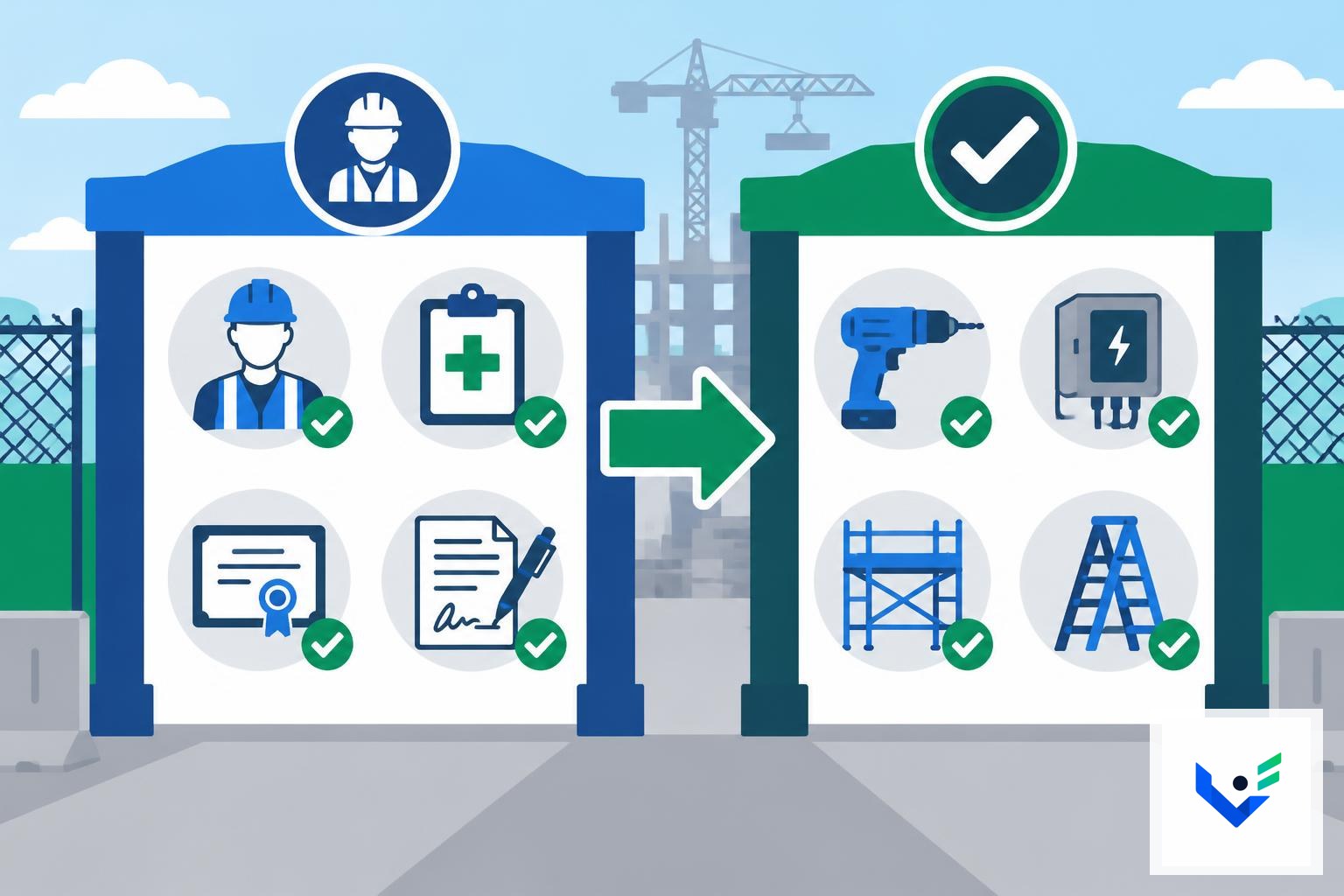
Two subcontractor admission gates on a construction site: first — worker, medical certificate, OHS training and cooperation agreement; second — power tools, site distribution board, scaffold and ladder — VIMS EHS illustration
Two admission gates: people and their documents first, then the equipment brought on site (illustrative image).

3. Why does a spreadsheet register of subcontractors fail on sites with high crew rotation?

Short answer: a spreadsheet stores dates but does not remind anyone of them, does not link document scans to a person and does not show a worker's status at the moment they stand at the gate. With a dozen companies and hundreds of people rotating during a contract, retyping medical and training dates takes the safety team's evenings, and a single error lets someone onto a scaffold without a valid certificate.

Typical problems anyone who ran contractor supervision in a spreadsheet will recognise: several versions of the same file on different computers, no clarity about which document copy is current, a lower-tier subcontractor the main contractor learns about only after an accident, and documents emailed in that nobody had time to verify.

A digital subcontractor file solves this when three conditions are met: every document is assigned to a company and person with an expiry date, the system automatically notifies both the safety team and the subcontractor of approaching deadlines, and the admission status (admitted, conditional, not admitted) is visible on a phone at the gate. This is how the contractor management module in VIMS EHS software works, linked with training and qualifications.

4. How should subcontractor equipment be admitted for use on site?

Short answer: equipment brought by a contractor should pass the same gate as people — it is declared, checked and marked before use. Polish construction safety regulations require machinery and technical equipment to be kept in good technical condition and used according to the manufacturer's instructions, and this applies to every employer whose workers use it.

Many main contractors apply an equipment admission procedure: the subcontractor submits a list of equipment with documents (power tool test records, technical inspection documents for UDT-supervised equipment, declarations of conformity), and the coordinator or an appointed person checks visual condition and applies an admission mark.

A popular method is quarterly colour coding — coloured tape or a sticker by the plug changes colour each quarter. A tool without the current colour may not be used on site. This is an internal practice, not a legal requirement, but every foreman understands it. Colour coding works well with a QR code leading to the inspection history of that specific item in the equipment register.

5. How often should power tools be inspected on site and how are site distribution boards checked?

Short answer: regulations do not give one test interval for all companies. The employer sets it based on manufacturer instructions, risk assessment and conditions of use, using standards on testing electrical equipment such as EN 50678 and EN 50699. On construction sites, where tools work in dust and moisture and suffer mechanical damage, intervals are usually shorter than in a workshop — which is why quarterly inspections are so common.

A periodic power tool test includes inspection of the housing, cable and plug and measurements — depending on protection class, among others protective conductor continuity and insulation resistance. It is performed by a person with suitable electrical qualifications and recorded in a test report. Regardless of periodic tests, the operator checks before each use that the cable and plug are undamaged.

A site distribution board powers the temporary site installation. Checks cover the enclosure and lock, circuit labelling, residual current device operation using the test button at the frequency set by the manufacturer, and periodic measurements of the installation including shock protection effectiveness by a qualified person. Each board should have a responsible person and the next measurement date in the register.

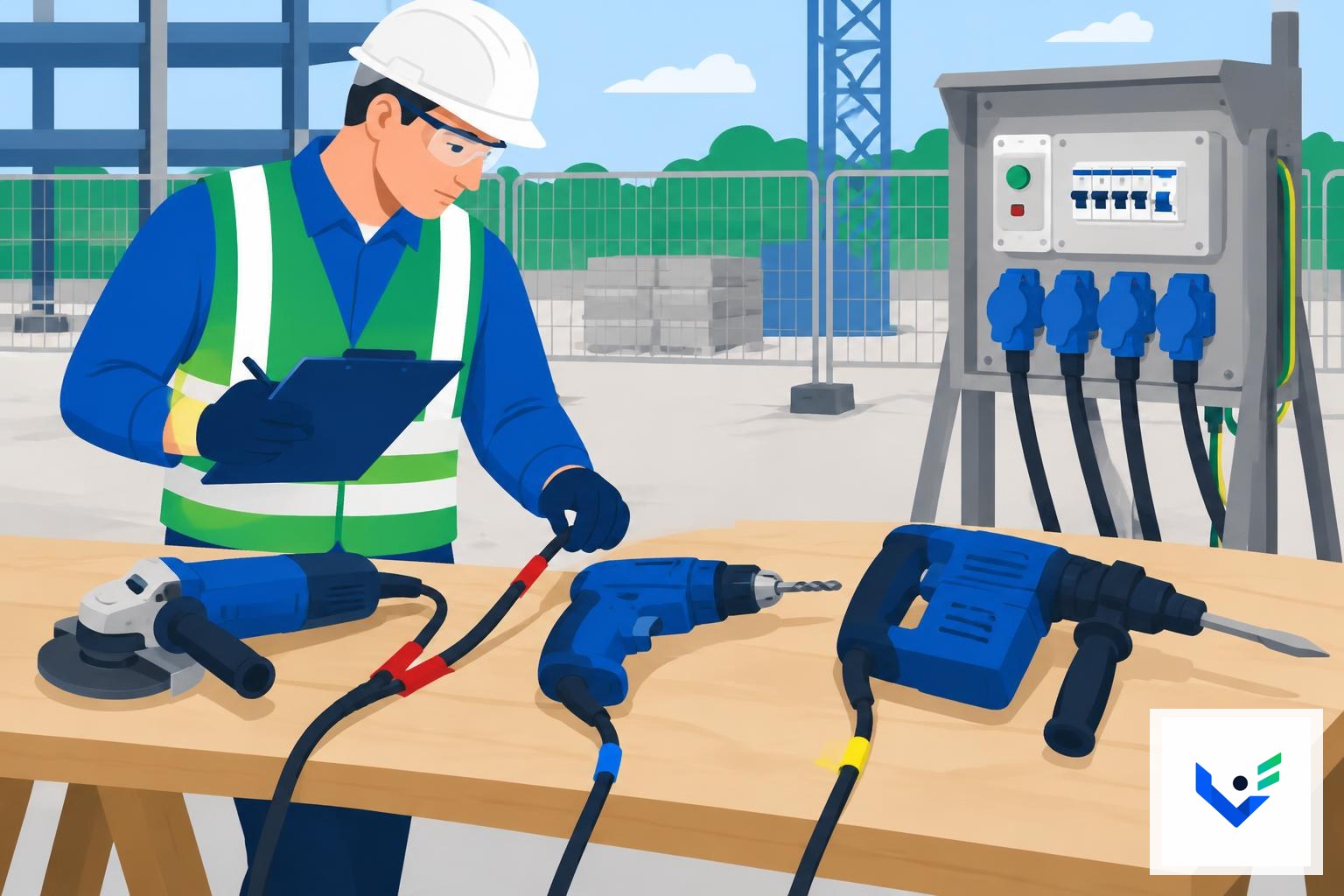
Power tool inspection on a construction site — worker checking a grinder, drill and hammer drill with quarterly colour tapes on cables, next to a site distribution board with residual current devices — VIMS EHS illustration
Colour coding on power tool cables and a site distribution board check (illustrative image).

6. Who hands over a scaffold, what does a scaffold handover record contain and when are ladders checked?

Short answer: in Poland a scaffold may be used only after acceptance by the site manager or an authorised person, confirmed by an entry in the site log or a handover record. Erection and dismantling are done by certified scaffold erectors according to the manufacturer's instructions or an individual design.

A scaffold handover record usually covers: location and type, the erecting company, intended use and permitted platform load, assessment of foundations, ties, bracing, platforms, guardrails and toe boards, lightning protection measurements where required, and signatures. Beyond handover, scaffolds are checked periodically and after any event that may affect stability — strong wind, heavy rain or a break in work.

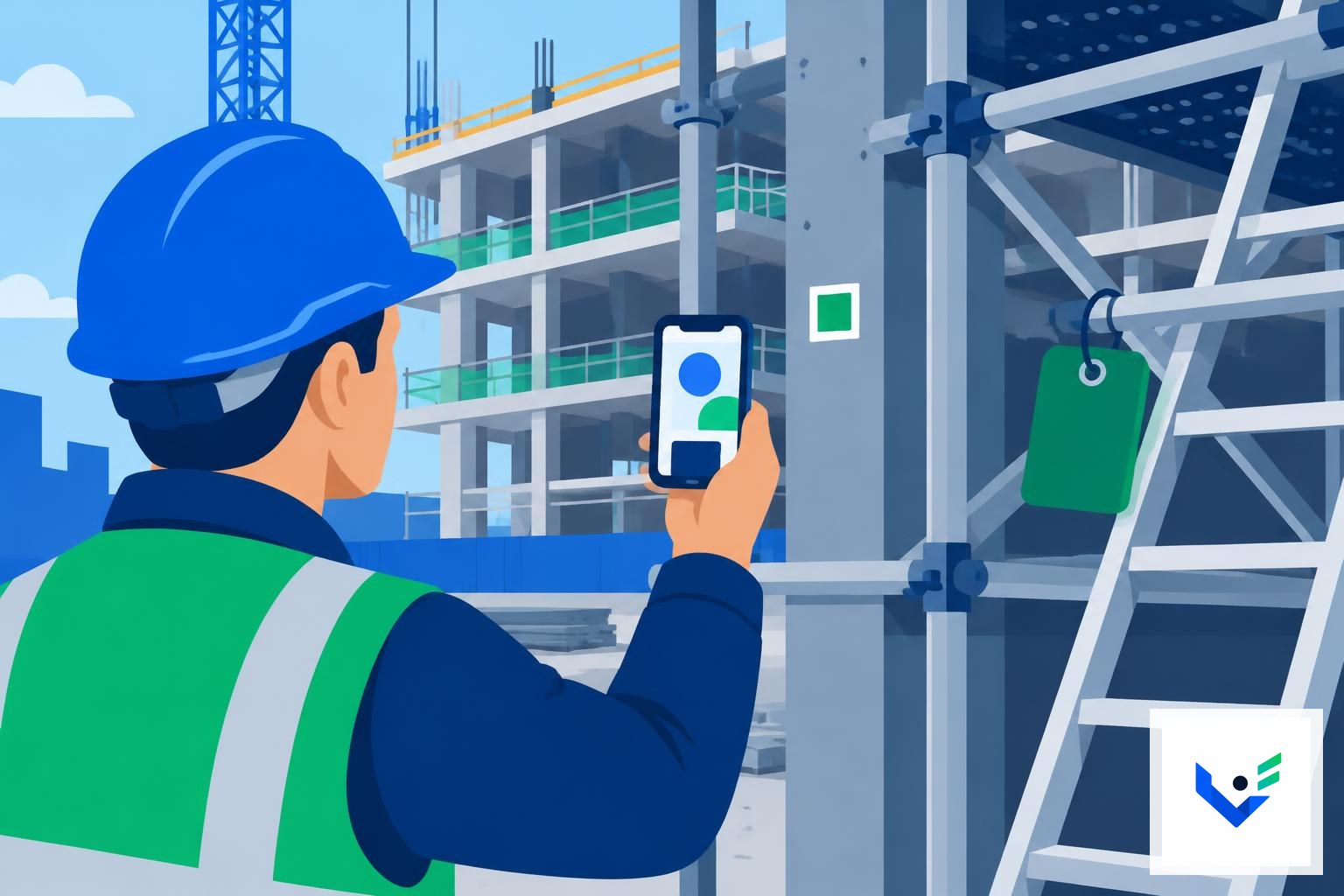
A clear way to inform workers is a scaffold tag at the access point — green means safe to use, red means do not enter. A QR code on the tag can lead to the handover record and inspection history. Ladders brought by subcontractors are treated the same way: a damaged, homemade ladder or one without feet must not be admitted. Detailed criteria are in the guide to ladder inspections under EN 131.

Scaffold handover on a construction site — inspector scanning a code on the scaffold with a phone, a green scaffold tag hanging at the access ladder — VIMS EHS illustration
Green scaffold tag and a code leading to the handover record (illustrative image, not a working code or system screen).

7. How should subcontractors be admitted to high-risk work — at height, in excavations and hot work?

Short answer: Polish construction safety regulations classify among particularly hazardous work, for example, work at height, in excavations deeper than 1.5 m, with hazardous materials and during structural assembly. For such work the site manager ensures direct supervision by an appointed person, and the contractor prepares a safe work method statement.

Many main contractors additionally require a written permit to work (PTW) for hot work, confined space entry and work on live installations. The permit defines scope, time, safeguards and authorised people, and closing it confirms the workplace is safe. See the guide to permits to work for high-risk tasks.

Immediately before starting, the subcontractor crew carries out a last minute risk assessment (LMRA) — a short list of questions about conditions at the work location. In VIMS EHS the permit to work takes the contractor from the subcontractor register, so at issue you see whether its workers have valid medicals and certificates, and the LMRA is completed on a phone at the workplace.

8. How is ongoing subcontractor supervision run after site entry?

Short answer: admission on day one is only the start. Ongoing supervision includes regular safety walks and inspections, recording non-conformities against a specific company, issuing corrective instructions with deadlines and verifying completion.

Good practice is to let every worker on site — subcontractors included — report a hazard, such as a damaged cable or a removed guardrail, without creating an account. Scanning a code on the site information board and adding a photo is enough. This is how hazard reporting without login works in VIMS.

The data collected allows objective assessment of subcontractors: number of non-conformities, time to close them, near misses and accidents. This assessment helps choose companies for future contracts and supports the conversation with a subcontractor that repeats the same failings.

Subcontractor admission on a construction site — what to check and when

Overview of basic checks; scope depends on the type of work, the contract and the site health and safety plan.

AreaWhat to checkWhen
Companyarticle 208 agreement, worker list, risk assessment, liability insurancebefore work starts
Workersmedical certificate, OHS training, induction, UDT and electrical certificatesat entry and before expiry
Power toolstest report, admission mark, condition of cable and plugon arrival, periodically, before use
Site distribution boardslock, circuit labelling, RCD test, measurementson connection and periodically
Scaffoldingacceptance by site manager or authorised person, scaffold tagbefore use, periodically, after events
Ladderscondition of rungs, feet and stiles, no homemade ladderson arrival and before use

Key takeaways

  • Labour Code article 208 requires employers to cooperate and appoint an OHS coordinator when workers of different companies work in one place.
  • The coordinator does not take over the subcontractor's duties to its workers but checks they are met.
  • The biggest risk is not a missing document on day one but one expiring during the contract.
  • Subcontractor equipment should pass the same admission procedure as people: declaration, check and marking.
  • A scaffold is used only after acceptance confirmed in the site log or a handover record.

Related modules

Contractor management

Contractors and external companies — oversight that starts before anyone enters the site

Collect the contractor's documents, verify their workers' qualifications, deliver the site induction and grant access before anyone passes the gate.

Explore the VIMS EHS module: Contractor management

Registers and inspections

Registers and periodic inspections — deadlines tracked by the system, not by memory

A plant runs a dozen parallel registers: cranes, pressure vessels, forklifts, extinguishers, hydrants, electrical installations, ladders, hoists, gates. Each has its own cycle and its own owner. This module brings them into one register with one calendar.

Explore the VIMS EHS module: Registers and inspections with reminders

Permit to work

Permit to work — an electronic workflow for high-risk activities

No more paper permits travelling around the site in search of a signature. The application, task risk assessment, approvals and working conditions run in one workflow visible to everyone involved.

Explore the VIMS EHS module: Permit to work (PTW)

LMRA

LMRA — the last check before anyone picks up a tool

A job risk assessment describes a workplace under typical conditions. LMRA answers a different question: is this work safe here, right now, with this crew?

Explore the VIMS EHS module: LMRA — pre-task risk check

QR / NFC access points

QR / NFC Access Points — everything about a zone in one scan, no login

A worker scans a code or taps a tag and instantly sees what applies to their zone: chemicals, instructions, LOTO, risks and a reporting form.

Explore the VIMS EHS module: Zero-login QR/NFC access points

Hazard reporting

Hazard reporting — the signal from the shop floor that does not get lost

The cheapest information in a plant is the one that arrives before an accident. This module shortens the path from spotting a hazard to deciding on an action, and makes sure the reporter hears back.

Explore the VIMS EHS module: Reporting issues from a phone

Frequently asked questions about subcontractor safety supervision on construction sites

Who is responsible for an accident involving a subcontractor's worker?

Primarily the worker's employer — the subcontractor — which also investigates the circumstances and causes. The responsibility of the main contractor and coordinator follows from article 208 of the Labour Code, the cooperation agreement and the site health and safety plan, and depends on the circumstances of the event.

Does a subcontractor need its own safety officer on site?

Whether a company must have an OHS service depends on its headcount, not on working at a construction site. In any case the subcontractor must provide training, medical examinations and PPE for its workers, and on site it is supervised by the coordinator appointed under article 208.

Who can accept a scaffold on a construction site?

The site manager or a qualified person authorised by them. Acceptance is confirmed by an entry in the site log or a scaffold handover record, and only then may the scaffold be used.

How often should power tools be inspected on a construction site?

There is no single statutory interval. The employer sets it based on manufacturer instructions, risk assessment and conditions of use. Sites often adopt quarterly inspections confirmed by colour coding, and operators check tools before each use.

What medical certificate does a worker need for work at height?

A valid certificate from occupational health examinations in which the doctor considered the work at height stated in the referral. The referral is issued by the employer — the subcontractor — and the site coordinator checks that the certificate covers the work performed.

How does the article 208 coordinator differ from the site health and safety plan?

The article 208 coordinator supervises the safety of workers of different employers working in one place. The site health and safety plan is prepared by the site manager under construction law and defines hazards and preventive measures for that site. In practice both roles are often handled by the same person or team of the main contractor.

Must lower-tier subcontractors also go through document checks?

Yes. Every company whose workers enter the site should be declared to the main contractor and pass the same document and equipment checks. It is worth stating this explicitly in the subcontract and in the OHS cooperation agreement.

Organise subcontractor supervision on your sites

See how VIMS brings subcontractor files, medical and training deadlines, QR-based equipment admission and permits to work together in one place.