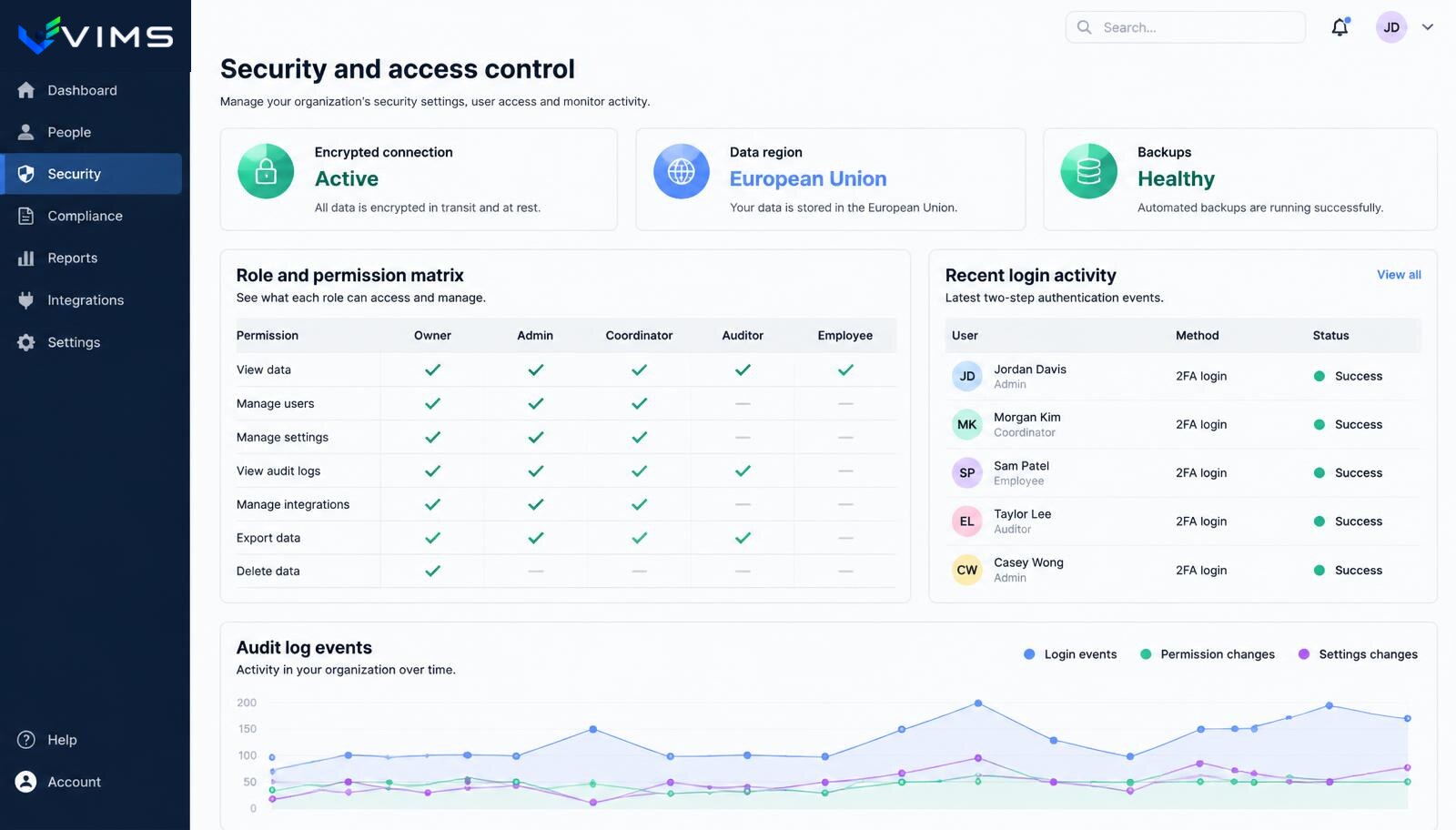
The security event log is written server-side, independently of anything the user does in the browser. Each entry holds an organisation identifier, a user identifier, an event name, a timestamp and a set of contextual data. Recorded events include login code delivery and successful verification, failed code delivery, enabling and disabling two-factor authentication, organisation creation, membership changes, data exports and sensitive-data reveals.
Beyond that log, the process modules keep their own history. An incident retains the trace of each investigation stage, a root cause analysis stores successive versions of its findings, and module configuration changes are recorded together with their author. During an external audit the conversation therefore moves past whether something was done, to when and by whom.
Business continuity rests on two independent layers. The first consists of automated backups of the whole data layer taken by the cloud infrastructure provider; they exist to rebuild the environment after a technical failure. The second, implemented inside the platform itself, works per organisation: every night the system prepares a separate archive for each company using VIMS and stores it in a private, non-indexed space inside the European Union region.
Each archive covers the organisation's operational data — the incident and accident register, concern reports, the chemical substances register with safety data sheets (SDS), root cause analyses, module configuration and the list of users with their roles. Archives are kept for fourteen days and are then deleted automatically, together with their registry entry. Outside the nightly schedule a backup can be taken on demand, for instance before a large configuration change or a data import.
Restoring is deliberately constrained. Only the highest technical role on the provider side can run it, after confirming identity with a one-time code sent by email and explicitly confirming the scope. Before the restore the system displays the archive contents with a record count per section and allows selecting only the areas to be recovered — no need to roll back a whole organisation to recover a single register. Immediately before data is overwritten an automatic safety copy of the current state is created, so the restore itself can be reversed. Every restore and every nightly run is written to the security event log.
We do not publish a contractual restoration time as a commercial standard — specific continuity parameters, including availability levels, are agreed individually in the contract where an organisation requires them.
Acceptances of legal documents — terms of service and the data processing policy — are stored together with the document version and date. When wording changes, it stays visible who accepted which version, which is often the first question during an inspection.