
VIMS EHSVIMS EHS

Safety harness and fall protection equipment inspections — intervals, competent person, markings and approval for use

Fall protection equipment — full-body harnesses, lanyards with energy absorbers, retractable type fall arresters, guided type fall arresters and connectors — is category III personal protective equipment under Regulation (EU) 2016/425, i.e. equipment protecting against risks that may cause death or irreversible damage to health. EN 365 requires such equipment to undergo a periodic examination at least every 12 months by a competent person, recorded on an equipment record card.

This guide answers the questions safety teams, PPE storekeepers and supervisors search for most: how often harnesses are inspected, who may inspect them, how to read the label and attachment points, how long a harness lasts, when it must be withdrawn and how to formally approve new equipment for use.

  • Safety harness inspection
  • EN 365
  • Fall protection equipment
  • Competent person
  • PPE record card
  • Harness service life

Published: 2026-11-12 · Updated: 2026-11-12 · 11 min read · Varilo deployment team

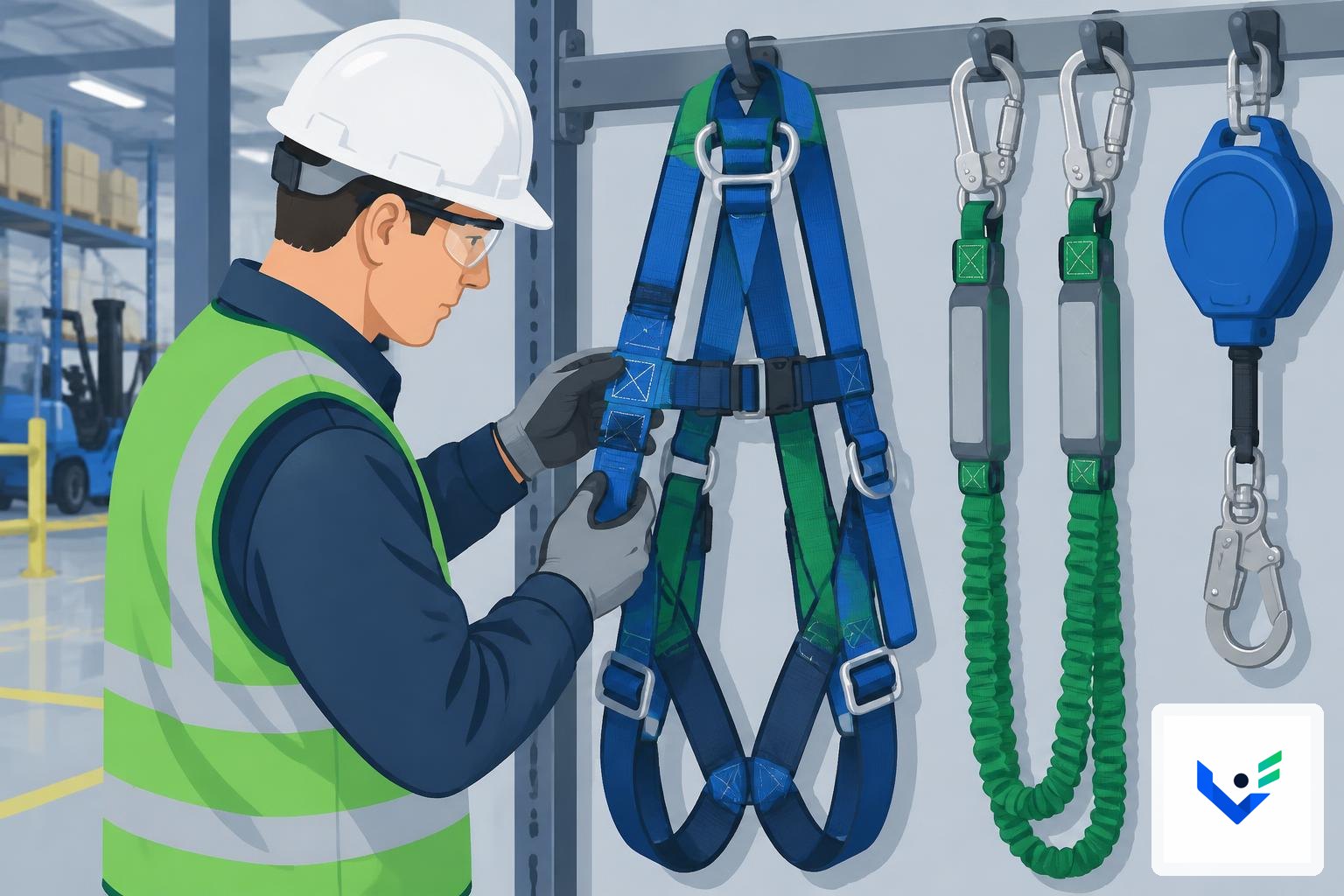
Safety harness inspection — helmeted competent person checking webbing and stitching of a harness hanging next to energy-absorbing lanyards and a retractable fall arrester — VIMS EHS illustration

1. When is work considered work at height and when must a worker wear a harness?

Short answer: under § 105 of the Polish general occupational safety regulation, work at height is work performed on a surface at least 1.0 m above floor or ground level. Work on a surface enclosed on all sides by solid walls at least 1.5 m high, or protected by other permanent structures preventing a fall, is not treated as work at height.

A harness is not the first choice but a complement. The regulation first requires collective protection — guardrails with a top rail at least 1.1 m high, a toe board and an intermediate rail, nets, platforms and mobile elevating work platforms. Only where collective protection cannot be used does the employer provide fall protection equipment matched to the task and the anchor point.

The Polish Labour Code adds that the employer supplies PPE meeting conformity assessment requirements free of charge (art. 237⁷), informs workers how to use it, and must not allow anyone to work without the required protection (art. 237⁹). Work at height usually also requires a valid medical certificate covering this factor and, in many plants, a written permit to work.
2. How often must a safety harness be inspected and what types of checks exist?

Short answer: fall protection equipment undergoes three types of checks. The pre-use check is done by the user according to the manufacturer's instructions. The periodic examination is done by a competent person at least every 12 months — as required by EN 365 and repeated in manufacturers' instructions. A special examination follows an arrested fall, contact with chemicals, heat or a sharp edge, and whenever the user doubts the equipment's condition.

Twelve months is a maximum, not a target. The manufacturer may require more frequent examinations under intensive use, in chemically aggressive or dusty environments, near welding or on construction sites. Retractable type fall arresters to EN 360 often additionally require servicing by the manufacturer or an authorised service centre — the instructions state whether an in-house competent person may limit the check to a visual examination or the device must be sent away.

Many searches ask for a harness “certificate”. In practice this means two different things: the manufacturer's evidence of conformity (CE marking with the notified body number and the EU declaration of conformity) and the record of a passed periodic examination on the equipment card.

3. Who may inspect a safety harness — what is a competent person?

Short answer: only a competent person may carry out the periodic examination — under EN 365, a person aware of the current periodic examination requirements and the manufacturer's recommendations and instructions applicable to the product. In practice this is someone trained by the manufacturer or its authorised representative to examine that brand's equipment, with documented training and, for many manufacturers, a periodically renewed authorisation.

Polish law provides no state licence for harness inspections, so the employer is responsible for ensuring the examiner holds the qualifications the manufacturer requires. It may be a trained employee or an external service provider. Training for one brand does not always cover another manufacturer's equipment — check the instructions and record it in the qualifications register.

The user must not be confused with the competent person. A worker must check the harness before putting it on and report damage, but this visual check does not replace the periodic examination and cannot be recorded on the equipment card as the annual inspection.

4. How to read a harness label and markings — what do A and A/2 mean?

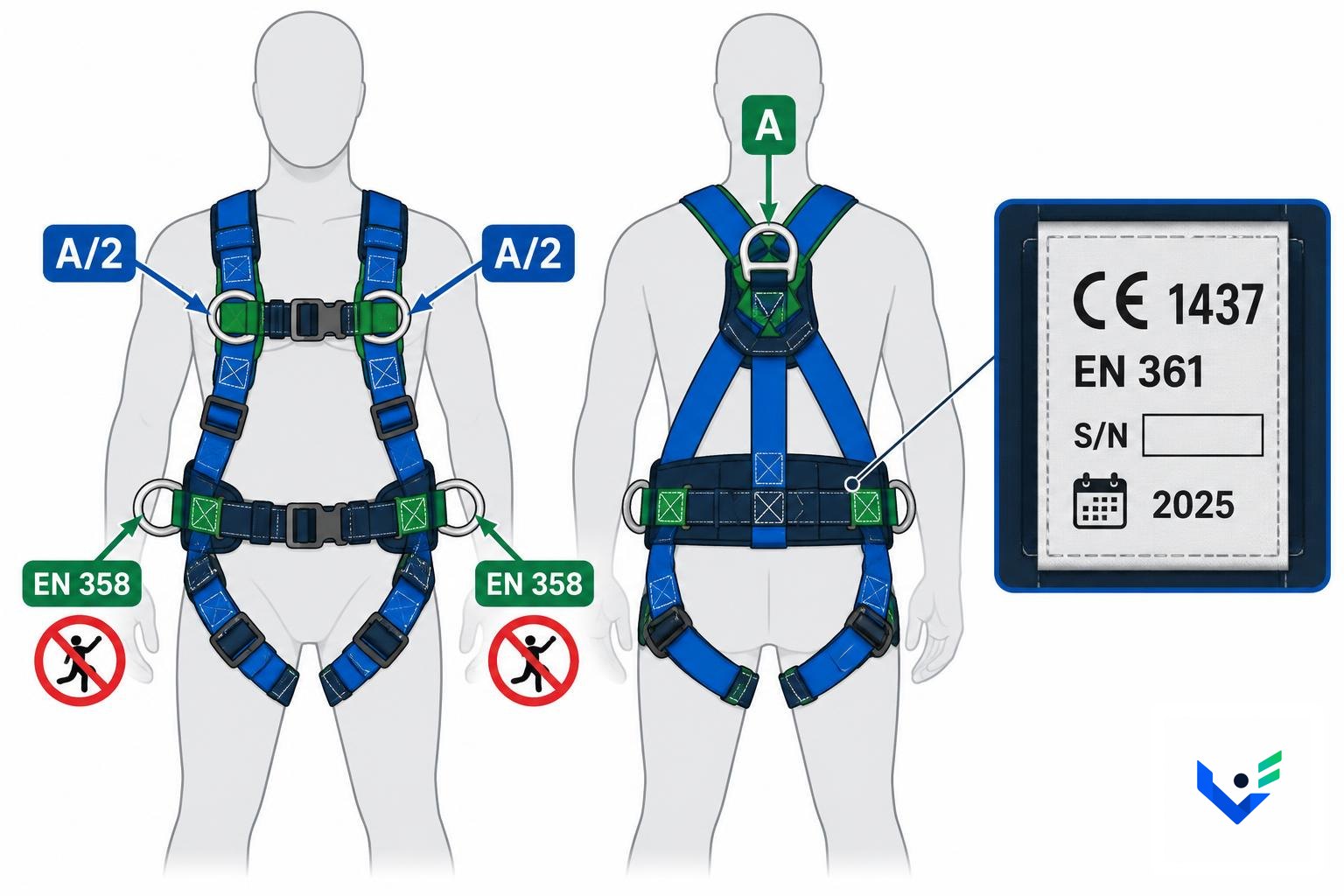
Short answer: a harness label shows at least the CE mark with the four-digit number of the notified body supervising production (for example 1437 is Poland's Central Institute for Labour Protection — National Research Institute), the standard number, the manufacturer's name or mark, model, size, serial or batch number, year and month of manufacture and a pictogram requiring users to read the instructions. Some manufacturers also state the maximum service life or its end date.

Attachment points are marked with the letter A. A single A at the dorsal or sternal buckle marks a point to which a fall arrest system may be connected on its own. A/2 on two chest loops means these points work only together — they must be joined with a connector; connecting the system to one A/2 loop is an error. Harnesses meeting EN 361 have at least one A point.

The side rings on the waist belt are work positioning points under EN 358. They hold the worker in position, for example on a pole or against a wall, and must never be used for fall arrest. Other system components carry similar markings: lanyards (EN 354), energy absorbers (EN 355), retractable type fall arresters (EN 360), guided type fall arresters on a flexible line (EN 353-2), connectors (EN 362) and anchor devices (EN 795).

Safety harness front and back: dorsal attachment point A, two sternal loops A/2, EN 358 side positioning rings with a no-fall-arrest symbol and a label with CE 1437, EN 361, serial number and year of manufacture — VIMS EHS infographic
A and A/2 attachment points, work positioning side rings and typical harness label elements (illustrative image).

5. How long does a safety harness last and when must it be withdrawn?

Short answer: the law sets no single harness expiry. The maximum service life is set by the manufacturer in the instructions — for textile products often several to over ten years from manufacture or first use, provided periodic examinations are passed. After that period the equipment is withdrawn even if it looks undamaged, because webbing and thread materials age under light, moisture and temperature.

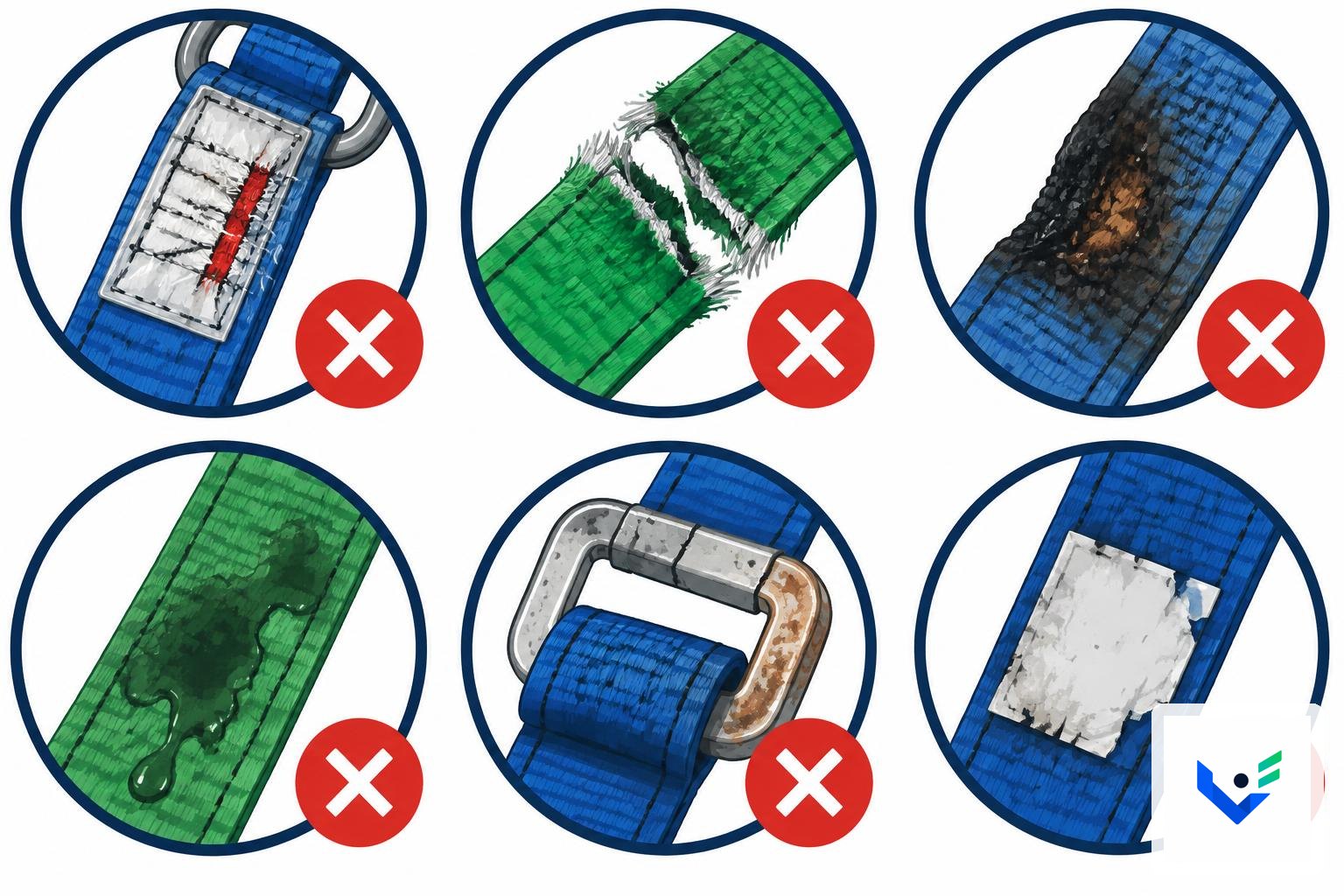
Regardless of age, equipment is withdrawn immediately when it has arrested a fall or the fall indicator has been activated (torn indicator stitching or deployed absorber), webbing is cut, frayed, burnt by welding sparks or discoloured by chemicals, stitching is loose, buckles and connectors are cracked, deformed or corroded, gates do not close automatically, the label is illegible or the equipment's history cannot be established. A harness that arrested a fall is not returned to use without a written decision of a competent person, and most manufacturers require unconditional withdrawal.

A withdrawn item must be physically separated from serviceable stock and permanently marked — ideally by cutting the webbing — and the withdrawal recorded on the equipment card. Harnesses simply put aside without marking regularly return to use at the next urgent job.

Safety harness withdrawal criteria: torn fall indicator, cut webbing, welding spark burn, chemical stain, cracked and corroded buckle and illegible label — VIMS EHS infographic
Six typical defects that require withdrawing the equipment from use (illustrative image).

6. How to approve a new safety harness for use on site?

Short answer: before issuing new equipment, check that the product carries the CE mark with the notified body number, an EU declaration of conformity or the address where it is available, and instructions in the user's language — as required by Regulation (EU) 2016/425. Then open an equipment record card and record the date of first use, from which the manufacturer usually counts the service life.

The equipment card required by EN 365 and manufacturers' instructions contains: name and model, manufacturer, serial number, year of manufacture, purchase and first-use dates, user or storage location, the history of periodic examinations with result and competent person's signature, repairs and the next examination date. The second pillar of approval is matching the system to the task: harness, lanyard or retractable, connector and anchor point must be compatible, and enough clearance must remain below the workstation for the fall to be arrested before striking the ground.

The last element is people. The worker should be instructed on the specific equipment, and the site should have a rescue plan for a worker suspended in a harness. Prolonged suspension can cause suspension trauma, so the method of rapid rescue is set before work starts, not at the moment of an accident.

7. How to keep harness records and inspections in VIMS EHS?

In the PPE register and issuing module each harness, lanyard or retractable has its own digital equipment card with serial number, manufacture and first-use dates, user and periodic examination history. VIMS EHS calculates the next examination date and the maximum service life and notifies the responsible person before the deadline.

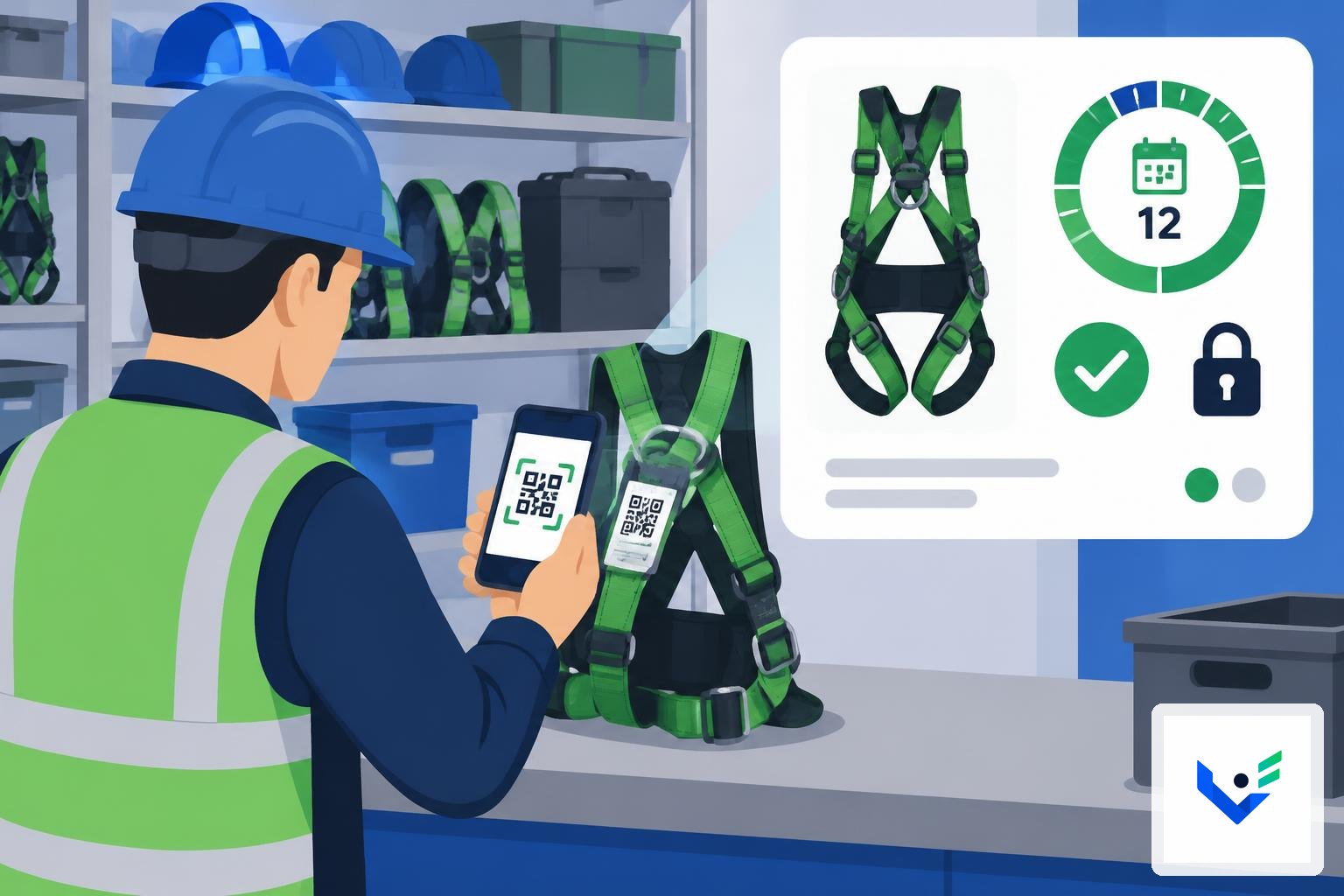
A QR code or NFC tag from the QR/NFC access points module can be attached to the item. The storekeeper scans the equipment at issue and immediately sees whether the examination is valid; the worker can check the card before putting the harness on and report damage from a phone. Competent person results go to the inspection register, and equipment that fails is marked as withdrawn. The deadline overview is ready to show a labour inspector or an ISO 45001 auditor.

The software organises deadlines and documentation but does not replace the competent person. The decision to approve or withdraw equipment is made by a person with the qualifications the manufacturer requires, based on a physical examination of the item.

Issuing a safety harness at the PPE store — worker scanning the harness QR code with a phone while a digital equipment card shows the 12-month periodic examination countdown and approval status — VIMS EHS illustration
Scanning the QR code at issue shows the examination date and the item's status (illustrative image, not an application screen).

8. Glossary: fall arrest, work positioning, fall indicator, clearance

A fall arrest system combines a harness, a connecting and energy-absorbing subsystem (lanyard with absorber, retractable or guided type fall arrester) and an anchor device; it stops a falling person and limits the force on the body. A work positioning system holds the worker at the workplace using an EN 358 belt, and a restraint system prevents the worker from reaching an edge from which a fall is possible.

A fall indicator — indicator stitching, a tear-off strip or a moving element of a retractable — permanently shows that the equipment has arrested a fall. Clearance is the minimum distance from the anchor point to the ground needed to arrest a fall safely; for absorber lanyards it is often several metres, so retractables are used at low heights.

An anchor device to EN 795 is the element the system connects to — a fixed point, a horizontal lifeline or a tripod. A competent person is trained to examine a given manufacturer's equipment, and an equipment card documents the item's history. More technical safety terms are in the EHS glossary, and ladder inspection rules in the ladder inspection guide.

Fall protection equipment checks — who and when

Based on EN 365 and typical manufacturer instructions. A specific product's instructions may require more frequent checks.

Check typeWhenPerformed byRecord
Pre-use checkbefore every useuserdefect report, if any
Periodic examinationat least every 12 months (more often per manufacturer)competent personequipment card with result and signature
Retractable servicingper manufacturer's instructionsmanufacturer or authorised serviceservice report and equipment card
Special examinationafter an arrested fall or exposure to chemicals, heat, sharp edgescompetent persondecision on further use or withdrawal
Withdrawalend of service life or failed examinationcompetent person or employercard entry, permanent marking of the item

Key takeaways

  • Harnesses and other fall protection equipment are category III PPE — a competent person examines them at least every 12 months.
  • The user's pre-use check does not replace the periodic examination.
  • An A point works alone, two A/2 loops only together, and EN 358 side rings are never used for fall arrest.
  • A harness that arrested a fall or reached the end of its service life is withdrawn and permanently marked.
  • An equipment card with serial number and examination history is the basis for approving an item for use.

Related modules

PPE store and issuance

PPE issuance and equipment records

A paper issue card works until the first real question: who received what, when, and whether that equipment is still fit for use. This module runs the PPE store as a register — from stock item and level, through the entitlement matrix, to a confirmed handover to a named person.

Explore the VIMS EHS module: PPE records and issuance

Registers and inspections

Registers and periodic inspections — deadlines tracked by the system, not by memory

A plant runs a dozen parallel registers: cranes, pressure vessels, forklifts, extinguishers, hydrants, electrical installations, ladders, hoists, gates. Each has its own cycle and its own owner. This module brings them into one register with one calendar.

Explore the VIMS EHS module: Registers and inspections with reminders

QR / NFC access points

QR / NFC Access Points — everything about a zone in one scan, no login

A worker scans a code or taps a tag and instantly sees what applies to their zone: chemicals, instructions, LOTO, risks and a reporting form.

Explore the VIMS EHS module: Zero-login QR/NFC access points

Permit to work

Permit to work — an electronic workflow for high-risk activities

No more paper permits travelling around the site in search of a signature. The application, task risk assessment, approvals and working conditions run in one workflow visible to everyone involved.

Explore the VIMS EHS module: Permit to work (PTW)

Safety training and employee qualifications

Training and qualifications — stop tracking expiry dates in a spreadsheet

See in one view who holds valid training and qualifications, whose certificates expire soon and what is missing for a given job.

Explore the VIMS EHS module: Training and qualification records

Frequently asked questions

How often should a safety harness be inspected?

A periodic examination at least every 12 months under EN 365, more often if the manufacturer or working conditions require. The user also checks the harness before every use.

Who can inspect a safety harness?

A competent person — trained by the manufacturer or its representative to examine that brand's equipment. It can be a trained employee or an external service provider.

How long is a safety harness valid?

The manufacturer sets the maximum service life in the instructions, counted from manufacture or first use. During that time the equipment needs a valid periodic examination. After it, the harness is withdrawn.

Can a harness be reused after a fall?

It should not be used. Equipment that arrested a fall is withdrawn immediately, and returning it to service requires a written decision of a competent person. Most manufacturers require unconditional withdrawal.

What do A and A/2 mean on a harness?

A marks a point to which a fall arrest system may be connected on its own. A/2 marks two loops that work only together, joined by a connector.

Does a harness need a certificate?

Required are the CE mark with the notified body number, an EU declaration of conformity and instructions in the user's language, and during use an equipment card with periodic examination results.

From what height is a harness required?

In Poland work at height starts at 1.0 m above floor or ground. Collective protection such as guardrails comes first; harnesses are provided where collective protection cannot be used.

Every harness record on your phone

See how VIMS keeps work-at-height equipment records with examination deadlines, QR codes at issue and the history of each item.