

VIMS EHSVIMS EHS

Machinery Regulation (EU) 2023/1230 from 2027 — what the new “Machinery Directive” means for plants, maintenance and safety teams

Regulation (EU) 2023/1230 of the European Parliament and of the Council on machinery replaces Machinery Directive 2006/42/EC and applies from 20 January 2027. It sets essential health and safety requirements for machinery placed on the market, defines substantial modification, allows instructions for use in digital form and introduces cybersecurity requirements for control systems.

People often search for the “new Machinery Directive 2027”, although the act is formally a regulation. This guide explains which changes apply to manufacturers and which to users — production plants, maintenance departments and safety teams — and how to prepare a machine fleet before January 2027.

  • Machinery Regulation 2023/1230
  • Machinery Directive 2027
  • Substantial modification
  • Digital instructions
  • Machine cybersecurity
  • CE marking

Published: 2026-11-12 · Updated: 2026-11-12 · 11 min read · Varilo deployment team

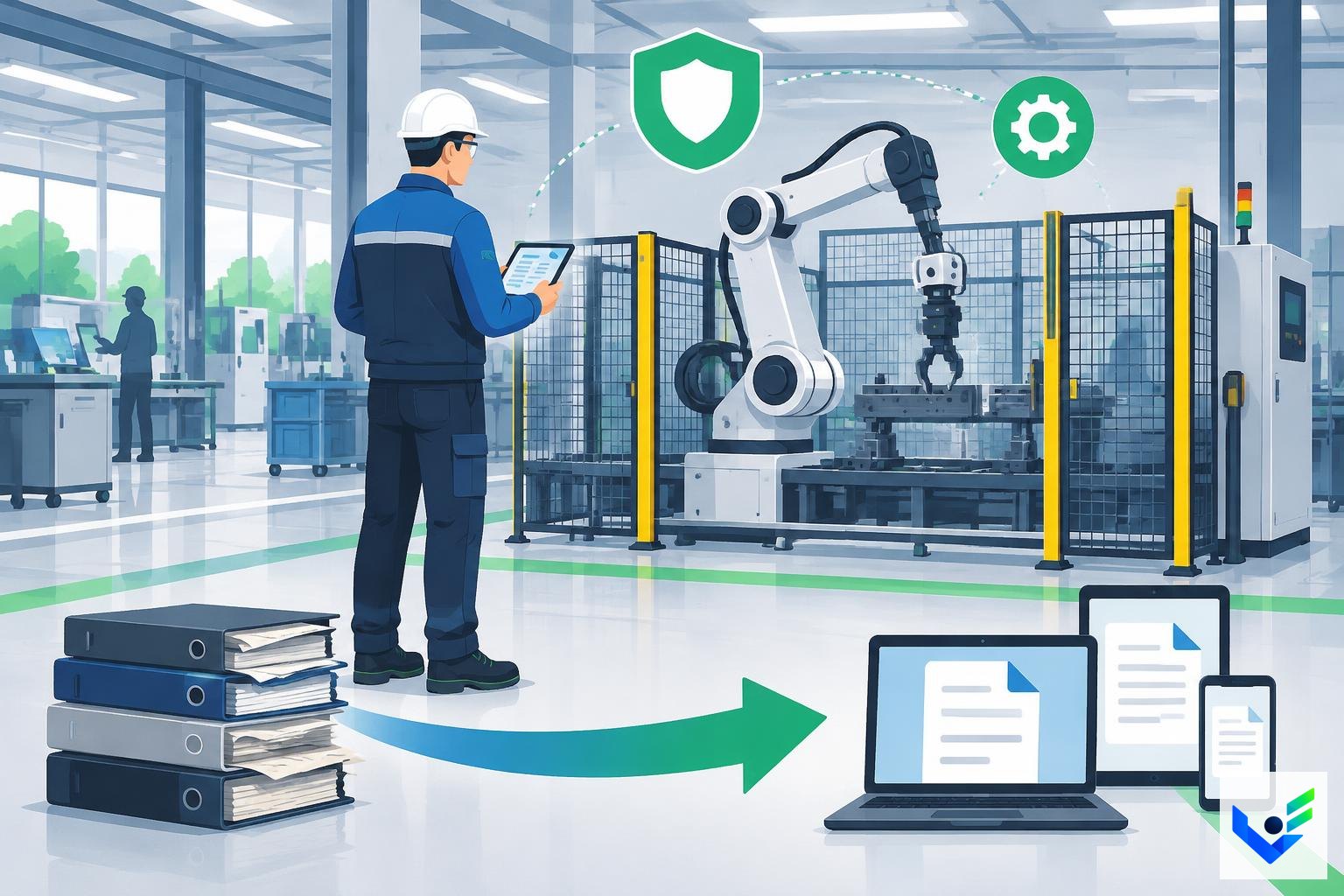
Machinery Regulation 2023/1230 from 2027 — maintenance engineer with a tablet next to a guarded robotic cell, moving from paper machine documentation to digital — VIMS EHS illustration

1. When does Machinery Regulation 2023/1230 apply and how does it differ from Directive 2006/42/EC?

Short answer: Regulation (EU) 2023/1230 entered into force in July 2023 and most of it applies from 20 January 2027. From that day, machinery placed on the EU market is assessed under the new rules and Directive 2006/42/EC is repealed.

The key difference is legal form. A directive had to be transposed into national law; a regulation applies directly and uniformly in every Member State, removing national differences in interpretation. The popular phrase “new Machinery Directive 2027” is therefore imprecise, but it refers to the same act.

The rules were updated after almost 20 years because machines have changed: collaborative robots, remote servicing over networks, control software updates and systems using machine learning. The 2006 directive did not clearly answer who is responsible for safety after a software update or how to protect safety functions from network interference.
2. Who does the regulation apply to — the manufacturer or the employer using machines?

Short answer: the regulation is addressed mainly to manufacturers, importers and distributors, but a production plant becomes subject to it in three situations: when it buys new machinery, when it builds a machine or line for its own use, and when it carries out a substantial modification of machinery already in use.

Everyday use of machinery is still governed by minimum requirements for work equipment: Directive 2009/104/EC and national rules (in Poland, the regulation on minimum OSH requirements for the use of machinery). The employer remains responsible for technical condition, inspections, workstation instructions, operator training and occupational risk assessment, regardless of when a machine was bought.

For purchasing, from 20 January 2027 the EU declaration of conformity for new machinery should refer to Regulation (EU) 2023/1230 rather than Directive 2006/42/EC. It is worth adding this condition to 2026 purchase specifications for machines delivered after that date.

3. What is a substantial modification and when does a plant become the manufacturer?

Short answer: a substantial modification is a change to machinery after it has been placed on the market or put into service, not foreseen or planned by the manufacturer, that affects safety by creating a new hazard or increasing an existing risk and requires added protective measures involving the control system or new guards. The definition is set out in Article 3 of the regulation.

The consequence is significant: whoever carries out a substantial modification — including an employer upgrading a machine in-house — is treated as the manufacturer for the modified part, or for the whole machine if the change affects its overall safety. They must perform risk assessment and conformity assessment, prepare technical documentation, instructions and a declaration of conformity, and affix the CE marking.

Typical maintenance situations that need analysis: adding a robot to an existing line, changing PLC logic in safety circuits, increasing drive speed or power, removing or rebuilding guards, or combining machines into an assembly with shared controls. Replacing a worn part with an identical or equivalent one, maintenance and repair according to the manufacturer's instructions are generally not substantial modifications.

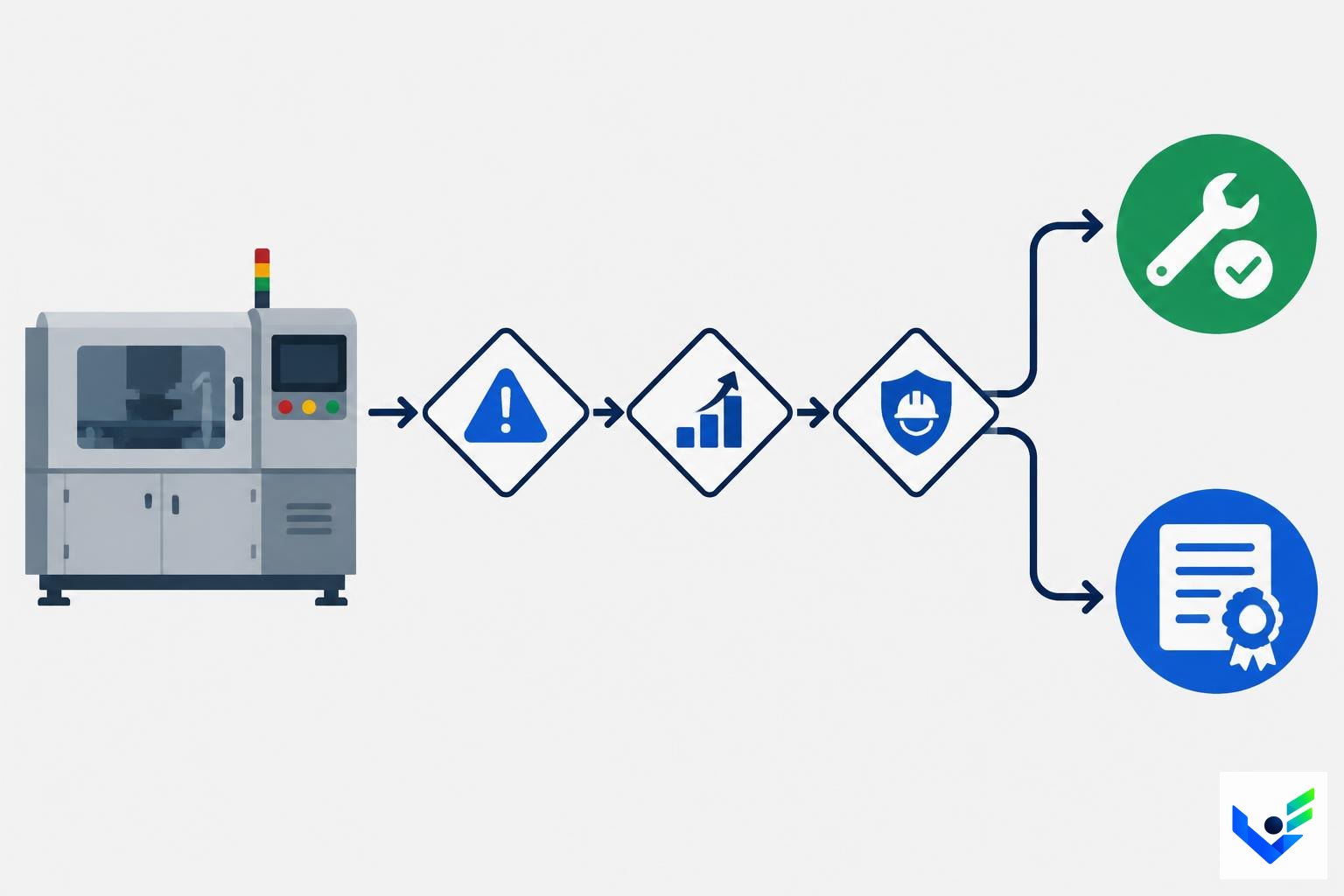
The boundary can be blurred, so the decision should not be made on the shop floor. A simple procedure works well: describe the planned change, check whether a new hazard appears or risk increases, whether existing safeguards suffice, and record a justified decision signed by a responsible person. In VIMS EHS this workflow runs in the management of change (MOC) module, linked to updating the occupational risk assessment.

Substantial modification decision flow under Machinery Regulation 2023/1230: new hazard, increased risk, adequacy of existing guards — outcome: repair and maintenance or new conformity assessment and CE marking — VIMS EHS illustration
Simplified decision path: repair and maintenance or a substantial modification requiring new conformity assessment (illustrative image).

4. Can machine instructions be digital only from 2027?

Short answer: yes, the regulation allows instructions for use in digital form, for example via a web address or a QR code on the machine, with conditions. On the buyer's request at the time of purchase, the manufacturer must provide a paper copy free of charge, and digital instructions must remain accessible for the machine's lifetime and at least 10 years after it was placed on the market. Safety information for non-professional users is still supplied on paper.

Manufacturer instructions must be distinguished from the workstation safety instruction the employer prepares under national OSH law. The regulation changes the form of the manufacturer's document; it does not release the plant from giving operators an up-to-date safe operating instruction at the workstation.

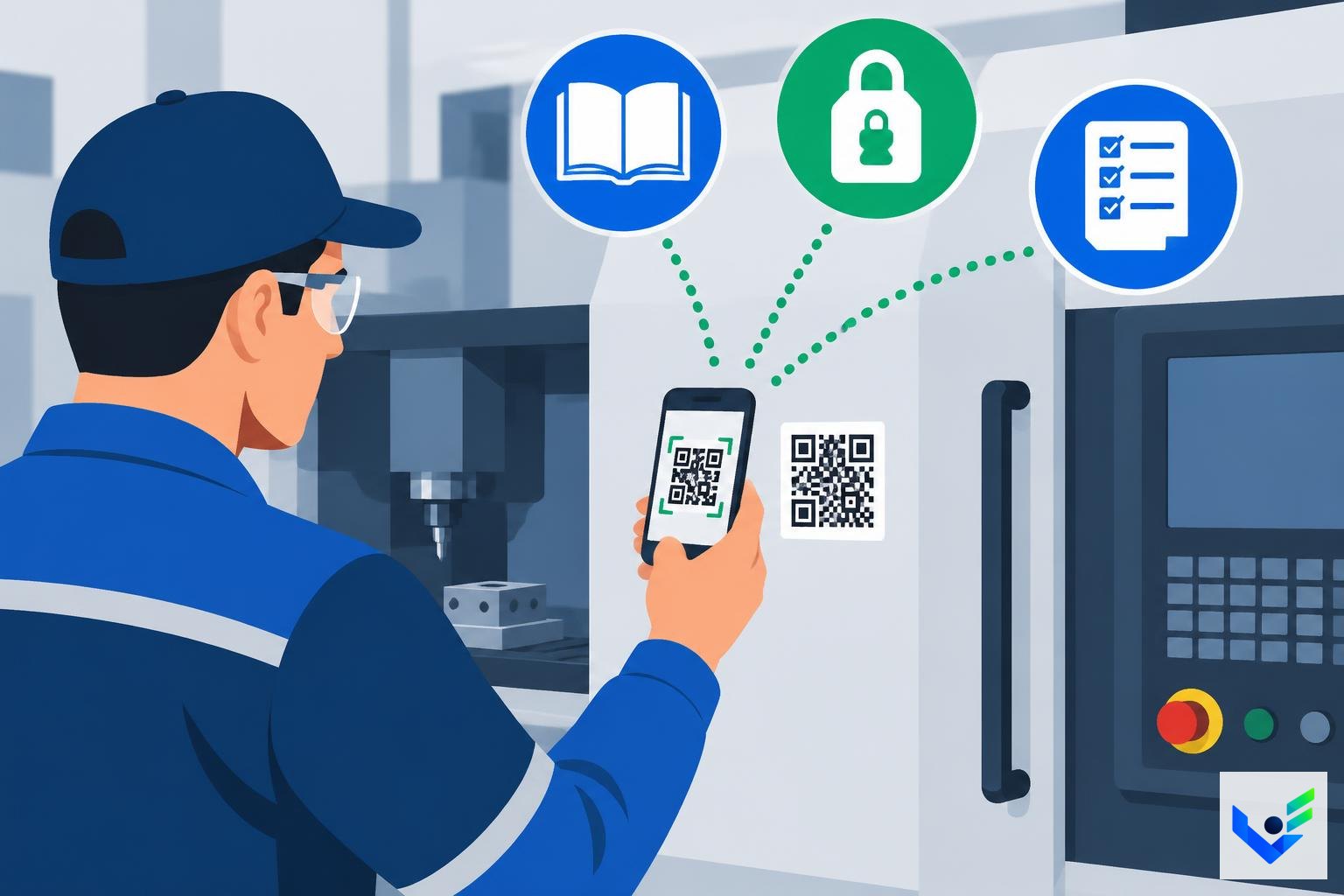
Digital form solves the problem of lost binders but creates a new one: the operator needs the right version when they need it. In VIMS EHS, QR and NFC access points on the machine lead to its record, and the instructions and procedures module stores the workstation instruction, LOTO procedure and manufacturer documentation with version history. See also QR codes and NFC tags in workplace safety.

Operator scanning a QR code on a CNC machine housing with a smartphone to open digital instructions for use, LOTO procedure and checklist under Machinery Regulation 2023/1230 — VIMS EHS illustration
A QR code on the machine giving access to instructions, LOTO procedure and checklist (illustrative image, not a system screenshot or a working code).

5. What cybersecurity and software requirements does the regulation introduce?

Short answer: the regulation adds an essential requirement for protection against corruption of the control system — connecting a machine to another device or network, including remote access, must not lead to a hazardous situation. Safety-critical software and data must be protected against accidental or intentional interference, and the machine must collect evidence of interventions in that software.

Control systems are also covered: a fault, logic error or loss of communication must not block the emergency stop or disable safety functions such as light curtains or guard interlocks. The regulation also addresses machinery with fully or partially self-evolving behaviour or logic — systems using machine learning — and some of them fall into categories requiring assessment by a notified body.

Practical conclusions for a plant: treat PLC software changes as technical changes, with a version log, an approver and a safety impact assessment. Manufacturer remote service should follow access rules agreed with IT. Technical details of protection, including the choice of harmonised standards, require consultation with a machinery safety and automation specialist.

6. Do machines bought before 2027 have to comply with the new regulation?

Short answer: no. Machinery placed on the market in compliance with Directive 2006/42/EC before 20 January 2027 does not need new conformity assessment just because the rules changed. Older machines must, however, meet the minimum requirements for the use of work equipment and be kept in safe working order.

The exception is a substantial modification carried out after 20 January 2027 — the modified machine is then assessed under the new rules. A machine register should therefore cover not only purchase date and declaration of conformity but also the modification history with a decision on whether each change was substantial.

Technical condition is confirmed by periodic checks, inspections per the manufacturer's instructions and, for equipment under statutory technical supervision, official inspections. In VIMS EHS the registers and inspections module keeps machine records, inspection schedules with reminders and phone checklists; similar principles are described in forklift inspections.

7. How to prepare a plant and machine fleet for January 2027 — step list

Short answer: preparation covers four areas — inventory of machinery and documentation, digital access to instructions at the workstation, a technical management of change procedure, and network security and energy isolation rules. None of them requires buying new machines.

Step 1 — inventory: list machines, assemblies and partly completed machinery, their declarations of conformity or incorporation, manufacturer instructions and the person responsible for each. Step 2 — document access: tag machines with QR codes or NFC tags leading to current workstation instructions and manufacturer documentation.

Step 3 — management of change: require every upgrade, software change or guard rebuild to go through an MOC request assessing whether it is a substantial modification. Step 4 — network and energy: agree remote access rules for controllers with IT and update LOTO procedures for machines upgraded in recent years.

Purchasing completes the picture: specifications for machines delivered after 20 January 2027 should require compliance with Regulation (EU) 2023/1230, define the language and form of instructions and how digital documentation is handed over.

Four steps to prepare a machine fleet for Machinery Regulation 2023/1230: machine inventory, digital instructions, management of change, cybersecurity and lockout — VIMS EHS illustration
Four preparation areas: inventory, digital instructions, management of change, network and lockout (illustrative image).

8. Glossary: partly completed machinery, assembly of machinery, essential and minimum requirements, notified body

Essential requirements are the health and safety requirements in Annex III of the regulation that a manufacturer must meet when placing machinery on the market. Minimum requirements apply to employers using machinery and come from Directive 2009/104/EC and national law.

Partly completed machinery cannot perform a specific application on its own and is intended to be incorporated into machinery — it is supplied with a declaration of incorporation and assembly instructions. An assembly of machinery is several machines linked to function as a whole, such as a production line with shared controls, and is assessed as a whole.

A notified body is an independent organisation designated to assess conformity of high-risk machinery categories listed in Annex I. A safety component is a hardware or software part that performs a safety function and whose failure endangers persons. EN ISO 12100 remains the basic standard for machinery risk assessment; the list of standards harmonised with the regulation is published by the European Commission.

Directive 2006/42/EC vs Regulation (EU) 2023/1230 — key differences

Changes relevant to a plant that buys, uses and upgrades machinery.

TopicDirective 2006/42/ECRegulation (EU) 2023/1230
Legal formdirective transposed into national lawregulation applying directly across the EU
Substantial modificationnot defined in the directive text, interpretive guidancedefined in law, modifier has manufacturer obligations
Instructions for usepaper formdigital form allowed, paper on request at purchase
Cybersecurityno explicit requirementsprotection of control system against corruption and log of software interventions
Machine learningnot regulatedrequirements for self-evolving systems, some assessed by a notified body

Key takeaways

  • Regulation (EU) 2023/1230 applies from 20 January 2027 and replaces Machinery Directive 2006/42/EC.
  • Machines placed on the market before that date need no new conformity assessment but must meet minimum requirements.
  • A substantial modification makes the plant responsible for the modified machine as its manufacturer, including conformity assessment and CE marking.
  • Manufacturer instructions may be digital but do not replace the employer's workstation safety instruction.
  • Every control software change and upgrade should pass through a documented management of change procedure.

Related modules

Management of Change (MOC)

Management of Change — assess the risk before the change reaches production

Most serious events do not come from routine work but from something new: a replaced unit, an altered parameter, a different raw material, a reshuffled crew. MOC brings order to the moment when risk appears that no assessment describes yet.

Explore the VIMS EHS module: Management of change (MOC)

Registers and inspections

Registers and periodic inspections — deadlines tracked by the system, not by memory

A plant runs a dozen parallel registers: cranes, pressure vessels, forklifts, extinguishers, hydrants, electrical installations, ladders, hoists, gates. Each has its own cycle and its own owner. This module brings them into one register with one calendar.

Explore the VIMS EHS module: Registers and inspections with reminders

QR / NFC access points

QR / NFC Access Points — everything about a zone in one scan, no login

A worker scans a code or taps a tag and instantly sees what applies to their zone: chemicals, instructions, LOTO, risks and a reporting form.

Explore the VIMS EHS module: Zero-login QR/NFC access points

Digital workplace safety instructions and kiosk

Workplace Instructions & Line Kiosk — the current safety instruction at every machine

One central register of safety instructions, LOTO procedures and workplace instructions, available at the machine via a QR code or a kiosk-mode tablet.

Explore the VIMS EHS module: Digital workplace safety instructions and kiosk

Occupational risk assessment

Risk assessment — a living document instead of a binder

Run risk assessment online: hazards, risk levels, control measures and reviews in one place, connected to what actually happens on site.

Explore the VIMS EHS module: Occupational risk assessment with AI

Frequently asked questions about Machinery Regulation 2023/1230

When does the new Machinery Regulation 2023/1230 apply?

Most of the regulation applies from 20 January 2027. From that date Directive 2006/42/EC is repealed and new machinery is placed on the market under the regulation. Some provisions, such as those on notified bodies, applied earlier.

Is the “new Machinery Directive 2027” the same as Regulation 2023/1230?

Yes. “New Machinery Directive” is a popular phrase. Formally, Directive 2006/42/EC is replaced by Regulation (EU) 2023/1230, which applies directly in all EU Member States without national transposition.

Are paper machine instructions banned from 2027?

No. The regulation allows digital instructions, but the buyer can request a free paper copy at the time of purchase. The employer must still give operators access to the workstation safety instruction at the place of work.

When does a machine upgrade require new CE marking?

When it is a substantial modification: a change not foreseen by the manufacturer that creates a new hazard or increases risk and requires new protective measures. The modifier then carries out conformity assessment, draws up a declaration of conformity and affixes the CE marking.

Must older machines in use comply with the 2027 regulation?

Not unless they are substantially modified. Machines in use must meet minimum OSH requirements for the use of machinery and be covered by inspections, workstation instructions and occupational risk assessment.

Is replacing a motor or PLC a substantial modification?

Not always. Replacement with an equivalent component of the same parameters is usually a repair. Increasing power or speed, or changing safety circuit logic, may be a substantial modification — document the decision in a management of change procedure.

Who in a plant is responsible for preparing for the Machinery Regulation?

The employer is responsible; in practice maintenance, engineering, the safety team, purchasing and IT share the tasks. Appointing an owner for the management of change process and the machine register works well.

Organise your machine fleet before January 2027

See how VIMS brings machine records, inspections, QR-linked instructions and management of change together in one place.