

VIMS EHSVIMS EHS

Running a one-person safety consultancy for several companies: documentation, deadlines and life after spreadsheets

An external occupational safety specialist is a person from outside the workplace to whom an employer, under art. 237¹¹ § 2 of the Polish Labour Code, entrusts the tasks of the occupational safety and health service. They must meet the same qualification requirements as an in-house safety officer, while responsibility for safety in the workplace remains with the employer (art. 207 § 1).

This guide draws on the experience of specialists who serve several, a dozen or several dozen small companies at the same time. It answers what one-person safety consultancies search for most: the legal basis for taking over safety service tasks, required qualifications, tracking periodic training and medical examinations across many clients, documenting recommendations and handling client employees' personal data. The legal references are Polish.

  • Independent safety consultant
  • External OSH service
  • Outsourced health and safety
  • Labour Code art. 237¹¹
  • Software for safety consultants
  • Training and medical exam deadlines

Published: 2026-11-12 · Updated: 2026-11-12 · 12 min read · Varilo deployment team

One-person safety consultancy — specialist at a desk serving a factory, warehouse, workshop, bakery and construction site connected to one dashboard — VIMS EHS illustration

1. On what basis can an external specialist take over safety service tasks?

Short answer: art. 237¹¹ of the Polish Labour Code. An employer with more than 100 employees creates an OSH service; an employer with up to 100 employees entrusts its tasks to an employee who also does other work. Where competent employees are lacking, the employer may — under § 2 — entrust the OSH service tasks to specialists from outside the workplace. This is the legal basis for a one-person safety consultancy.

The smallest firms have another option: an employer with up to 10 employees, or up to 50 employees in an activity group with a risk category no higher than three, may perform the tasks personally after suitable training (art. 237¹¹ § 1¹). Many still outsource them because they lack time to track deadlines and regulatory changes.

The scope follows the Council of Ministers regulation on the OSH service: inspecting working conditions, informing the employer of hazards with proposals to remove them, taking part in occupational risk assessment and accident investigations, advising on regulations and helping organise training. A good client contract states which tasks the specialist performs, how often they visit and how results are reported.
2. What qualifications does a one-person safety consultancy need?

Short answer: the same as an OSH service employee in the equivalent position. The regulation requires external specialists to meet the qualification requirements of the service — for example, an OSH inspector needs at least secondary education with an OSH technician title, and an OSH specialist needs relevant higher education or postgraduate OSH studies plus at least one year of experience in the service. Senior positions require longer experience.

In addition, periodic training for OSH service staff and persons performing its tasks is repeated at least every 5 years under the regulation on OSH training. Clients may ask for diplomas and certificates, so it pays to keep them in one place.

Specialists who run periodic training for client employees should check the capacity in which they do so: periodic training is organised by the employer or, on its behalf, by an organisation conducting OSH training. Formal obligations of training providers should be verified individually.

3. Who is responsible for safety at the client — the employer or the external specialist?

Short answer: the employer. Art. 207 § 1 of the Labour Code states that the employer is responsible for safety and health in the workplace, and outsourcing the OSH service does not change that. The specialist is liable for proper performance of the contract, and where neglect of their own duties exposed workers to danger, criminal liability of a person responsible for occupational safety (art. 220 of the Polish Criminal Code) cannot be ruled out. Specific cases always require legal advice.

The most common worry is: “I reported a hazard, the employer didn't fix it, then an accident happened.” The best protection is proof of handover: when the hazard was found, to whom and how the recommendation was passed, what deadline was proposed and whether the employer responded. Verbal remarks leave no trail; a dated record with a photo and acknowledgement does.

In VIMS every finding from an inspection or walk is stored with date, author, photo and an assigned person at the client, and the change history shows when the recommendation was sent, read and closed. This does not shift responsibility, but it organises evidence for a labour inspection or accident investigation.

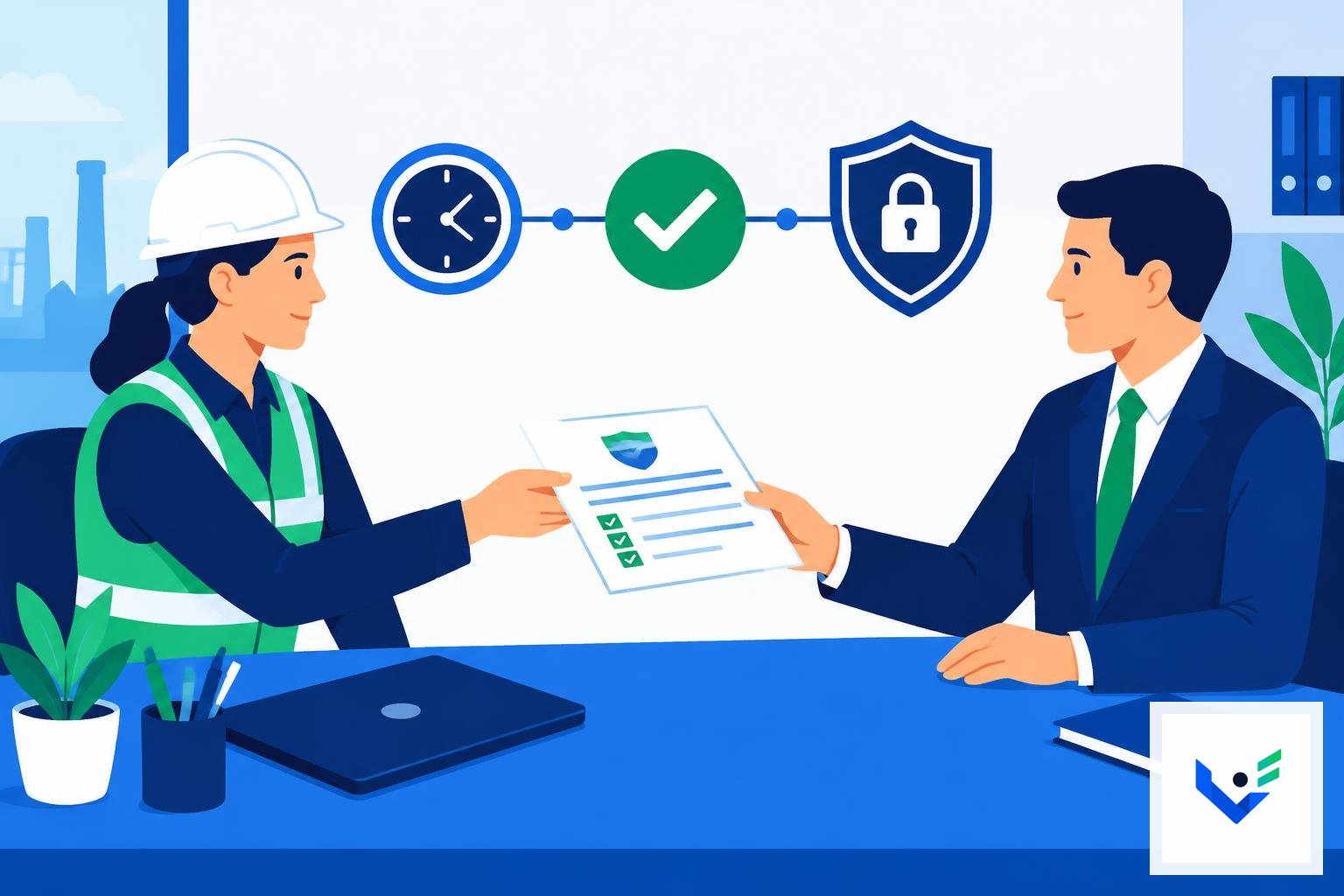
External safety specialist handing recommendations to an employer under a timeline with a clock, confirmation and data-protection shield — VIMS EHS illustration
Illustrative image: a documented handover of recommendations protects both parties.

4. Why do separate spreadsheets stop working with several clients?

Short answer: a spreadsheet does not send reminders, does not link data and does not show which version is current. With one client, discipline is enough. With five, copies appear on the laptop, in email and on a USB stick; with ten, the specialist checks a dozen tabs every week to catch expiring training and medical examinations.

Typical problems: a new client employee is added late because HR did not pass the information on; a leaver still shows as “overdue”; dates from medical certificates are retyped with errors; the client cannot see the state of its records without being sent a file. None of this is a knowledge gap — it is the lack of a tool that keeps the data in order.

Many people search for a ready “training and medical exam register template in Excel”. A template solves the first client's problem, not the tenth's. We compare both approaches in Excel vs EHS software.

5. How do you track periodic safety training and medical exams across many clients?

Short answer: in one dashboard that collects deadlines from all client companies and reminds you about expiring ones. Under Polish rules, induction training precedes work, periodic training for manual workers is repeated at least every 3 years (annually for particularly hazardous work) and every 5 or 6 years for other groups, while the occupational physician sets the next medical examination date. Details are in our safety training guide.

In VIMS the specialist sees each client separately but can review deadlines from all of them on one list. The training and qualifications module calculates next training dates and the medical examinations module keeps exam dates and certificate conclusions without storing medical details. Reminders go to the specialist and, if the client wishes, to a contact person at the company.

Splitting duties saves the most time: the client's HR adds or imports employees, and the specialist looks after deadlines and training content. New starters appear before their first day, not a month later.

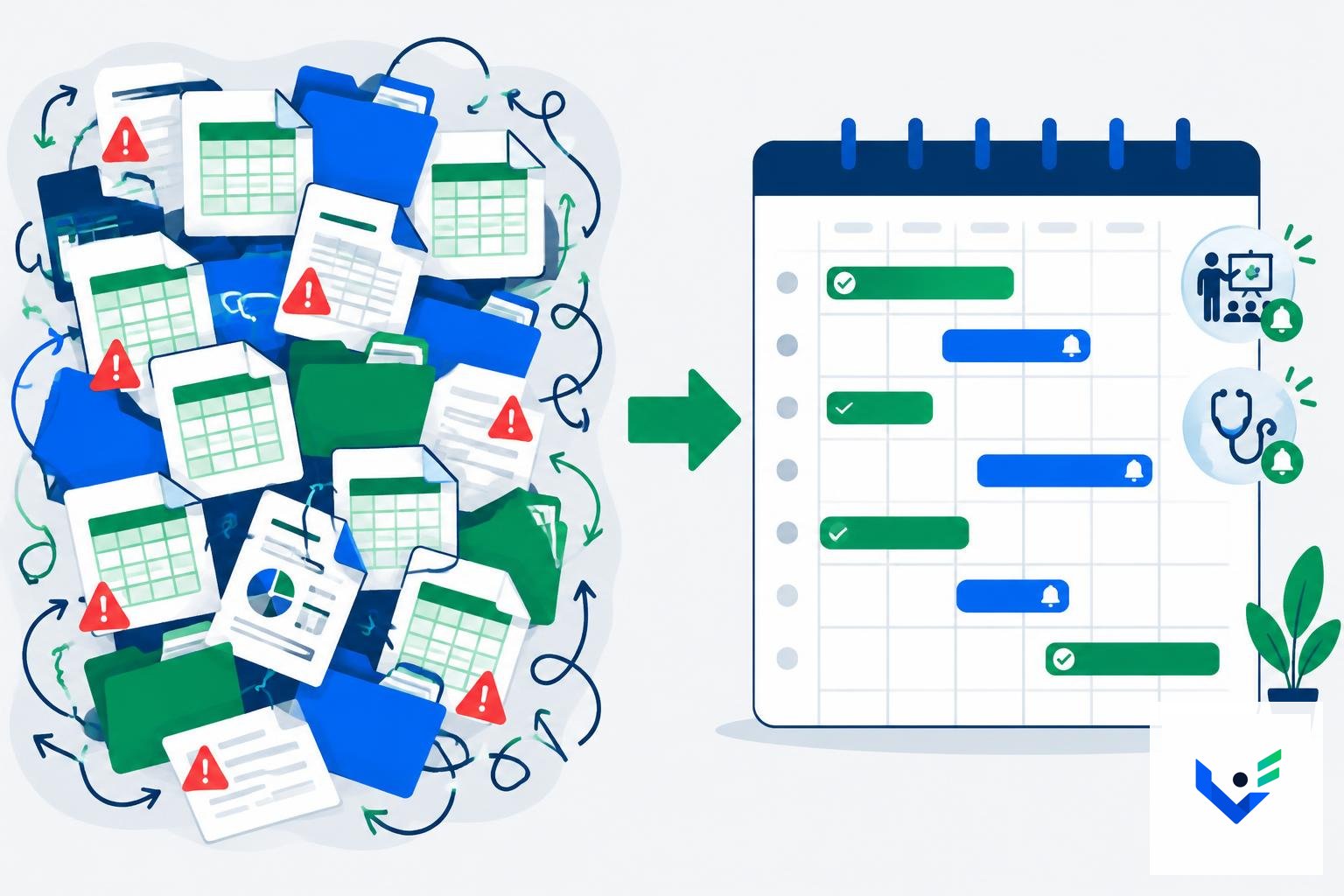
Left: a pile of spreadsheets and folders with warnings; right: one organised schedule of safety training and medical exams with reminders — VIMS EHS illustration
Illustrative image: many separate spreadsheets replaced by one deadline schedule.

6. How do you run a client safety audit so the report is ready on the spot?

Short answer: record findings on the phone during the walk instead of retyping notes afterwards. Inspection and audit checklist templates are among the most searched items by external specialists because documenting visits takes the most time.

In VIMS the audits and inspections checklist works on a phone. Each finding has a photo, location, hazard category, proposed deadline and responsible person at the client. When the walk ends, the report is built from the collected data, and open recommendations carry over to the next visit as items to verify.

The same findings support occupational risk assessment updates and the annual safety analysis the OSH service presents to the employer, without retyping.

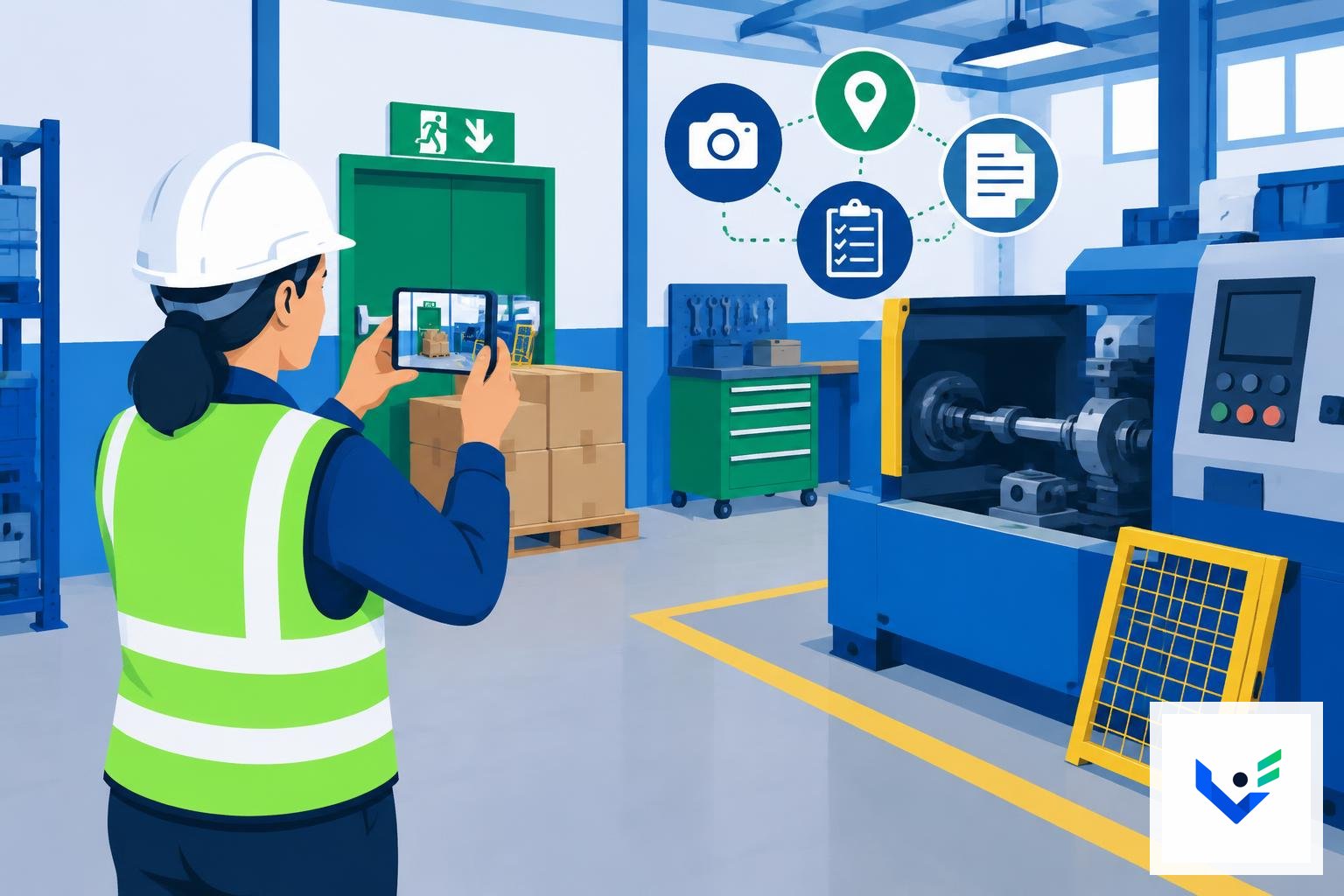
Safety specialist in helmet and hi-vis vest photographing a blocked emergency exit and a removed machine guard during a client audit — VIMS EHS illustration
Illustrative image: walk findings recorded immediately, with photo and location.

7. How should an external safety service handle client employees' personal data (GDPR)?

Short answer: usually as a processor acting on behalf of the employer, under a data processing agreement compliant with art. 28 GDPR. The employer remains the controller, and the specialist processes only what OSH tasks require: name, position, training dates, exam deadlines and certificate conclusions.

Health data (art. 9 GDPR) needs particular care. Deadline tracking needs only the exam date, the next exam date and the conclusion “fit” or “not fit”. Diagnoses and medical details should not enter the specialist's register. Each client's data must also be kept separate — one shared spreadsheet for several companies is one of the easiest ways to breach confidentiality.

In VIMS partner plans every client company has a separate data space. The data belongs to the company, not the partner: the client can buy its own subscription at any time and take over the data with full history, while the partner keeps access as an invited specialist.

8. How many companies can one person serve, and what does consultant software cost?

Short answer: the number of clients is limited by time for site visits, not by administration — provided administration is automated. Regulations set no limit on companies per specialist; they set tasks that must be performed properly for each client. The fewer hours spent retyping dates and writing reports, the more remain for presence on site, conversations with workers and training.

For one-person and small safety consultancies VIMS has a separate pricing track — partner plans. Partner Micro covers up to 5 client companies, Partner Standard up to 15 and Partner Pro up to 30; each company includes up to 50 employees and 1 site, with the employee limit extendable in Standard and Pro after an individual consultation. Current prices and features are on the pricing page.

Before deciding, count your own time: how many hours a month go on reviewing spreadsheets, reminding clients about deadlines and retyping walk notes. Consultant software makes sense when it gives those hours back to substantive work or to more clients. You can join the VIMS testing programme via the contact page.

Serving several companies in spreadsheets vs a VIMS partner plan

The comparison concerns the external specialist's administrative work. Legal duties are the same in both cases.

AreaSeparate spreadsheets and foldersVIMS partner plan
Training and exam deadlinesManually checking each client's filesOne deadline list across all companies, with reminders
Starters and leaversDependent on an HR email and manual updateClient HR can update the employee list themselves
Walks and auditsNotes, photos in the gallery, report written afterwardsPhone checklist, photos attached to findings, report from collected data
Proof of recommendationsEmail or signature on a printoutHistory with sent, read and closed dates
Separation of client dataDependent on file-naming disciplineSeparate data space for each company
Client takes overFiles handed over without historyClient takes data with full history onto its own subscription

Checklist for a one-person safety consultancy

  • The client contract relies on art. 237¹¹ § 2 and states tasks, visit frequency and report format.
  • Qualifications and current OSH service periodic training are documented and available to the client.
  • A data processing agreement is in place with every client.
  • The register holds no medical details — only deadlines and certificate conclusions.
  • Every recommendation has a date, recipient, deadline and proof of handover.
  • Deadlines for all clients are visible in one place, with reminders.
  • Each company's data is stored separately.

Related modules

Safety training and employee qualifications

Training and qualifications — stop tracking expiry dates in a spreadsheet

See in one view who holds valid training and qualifications, whose certificates expire soon and what is missing for a given job.

Explore the VIMS EHS module: Training and qualification records

Medical examinations

Medical examinations — certificate validity tracked without paging through files

An expired medical certificate means a worker cannot be allowed to work. With a hundred people a spreadsheet still copes. With several hundred, turnover and shift work you need a register that raises upcoming dates by itself.

Explore the VIMS EHS module: Medical examinations with due-date reminders

Rounds and inspections

Rounds and inspections — regular presence on the floor instead of a quarterly report

A safety walkaround is a cheap prevention tool, but only when it happens regularly and ends with an assigned task. This module enforces both conditions.

Explore the VIMS EHS module: Rounds with QR and NFC codes

Internal audits and safety inspections

Audits and inspections — from checklist to a closed nonconformity

Plan an audit or round, run it from a phone, record nonconformities and launch actions immediately — without retyping results into a spreadsheet.

Explore the VIMS EHS module: Audits and inspections in one system

Occupational risk assessment

Risk assessment — a living document instead of a binder

Run risk assessment online: hazards, risk levels, control measures and reviews in one place, connected to what actually happens on site.

Explore the VIMS EHS module: Occupational risk assessment with AI

Workplace accidents and near misses

Accidents and incidents — the full investigation workflow without spreadsheets

Report an event in seconds, run the root cause analysis, plan actions and close the case with complete documentation in one place.

Explore the VIMS EHS module: Accident and event recording

Frequently asked questions from external safety specialists

Can safety services be provided as a sole trader?

Yes. Art. 237¹¹ § 2 of the Polish Labour Code lets employers entrust OSH service tasks to specialists from outside the workplace, who must meet the service's qualification requirements.

Who is responsible for safety if a company uses an external specialist?

The employer (art. 207 § 1). The specialist is liable for proper performance of the contract, so documenting each recommendation handover is worthwhile.

How often should an external safety specialist visit a client?

There is no single statutory frequency. It follows from the contract, the size of the workplace, its hazards and the tasks taken over, and should be written into the contract.

Does an external safety firm need a data processing agreement?

Usually yes. The specialist processes employee data on the employer's behalf, so an agreement under art. 28 GDPR defining scope and purpose is needed.

How often is periodic training required for OSH service staff?

At least every 5 years under the Polish regulation on OSH training, including persons performing the service's tasks as external specialists.

What software suits a consultant serving several companies?

Software that separates client data, gathers all deadlines in one place and lets you document walks on a phone. VIMS offers partner plans for 5, 15 or 30 companies.

What happens to the data when a client ends external service?

In VIMS the data belongs to the client company. It can buy its own subscription and take over the data with history; the partner may keep access as an invited specialist.

All your clients in one dashboard

See how VIMS partner plans help one-person safety consultancies track deadlines, document walks and keep each company's data separate.