
VIMS EHSVIMS EHS

Emergency safety showers and eyewash stations — regulations, placement, testing and inspection records

An emergency safety shower drenches the whole body of a worker splashed with a corrosive substance or whose clothing has caught fire. An eyewash station rinses the eyes and face. In Poland the duty to install them follows from § 103 of the general OSH regulation; technical parameters are described in EN 15154.

This guide answers what safety officers, maintenance teams and chemical store managers search for most: when a safety shower is mandatory, how far it may be from the workstation, what water it needs, how often to test it, whether a portable eyewash bottle is enough and how to record tests. Legal references are Polish; we separate legal duties from standards and manufacturer guidance.

  • Emergency shower
  • Safety shower
  • Eyewash station
  • EN 15154
  • Equipment inspections

Published: 2026-11-12 · Updated: 2026-11-12 · 9 min read · Varilo deployment team

Chemical warehouse with a green emergency shower and eyewash station, safety signs and a clear route from the workstation — VIMS EHS illustration

1. When are an emergency shower and eyewash station mandatory?

Short answer: whenever work processes involve a risk of workers being splashed with corrosive substances or their clothing catching fire. § 103(1) of the Polish general OSH regulation requires emergency showers for the whole body and separate eyewash showers. Based on the available consolidated text, this provision is unchanged by the amendment in force from 11 January 2027.

Typical locations include chemical stores and filling areas, battery charging rooms, laboratories, electroplating shops, water treatment plants and paint shops. Sector regulations may add requirements.

Start from the occupational risk assessment and safety data sheets: section 4 covers first aid, including eye and skin rinsing, and section 8 exposure controls.
2. How far from the workstation may an emergency shower be?

Short answer: under § 103(1) — no more than 20 m horizontally from the hazardous workstation. ANSI/ISEA Z358.1 also recommends reaching the unit within about 10 seconds; in Poland this is good practice, not law.

The route must be free of steps, locked doors and stored goods. § 103(2) requires immediate activation, automatic or otherwise, taking into account the reduced ability of the injured person — hence large levers, triangular pull rods and foot pedals.

Mark units with ISO 7010 signs E012 (safety shower) and E011 (eyewash station) and show them on the site safety map.

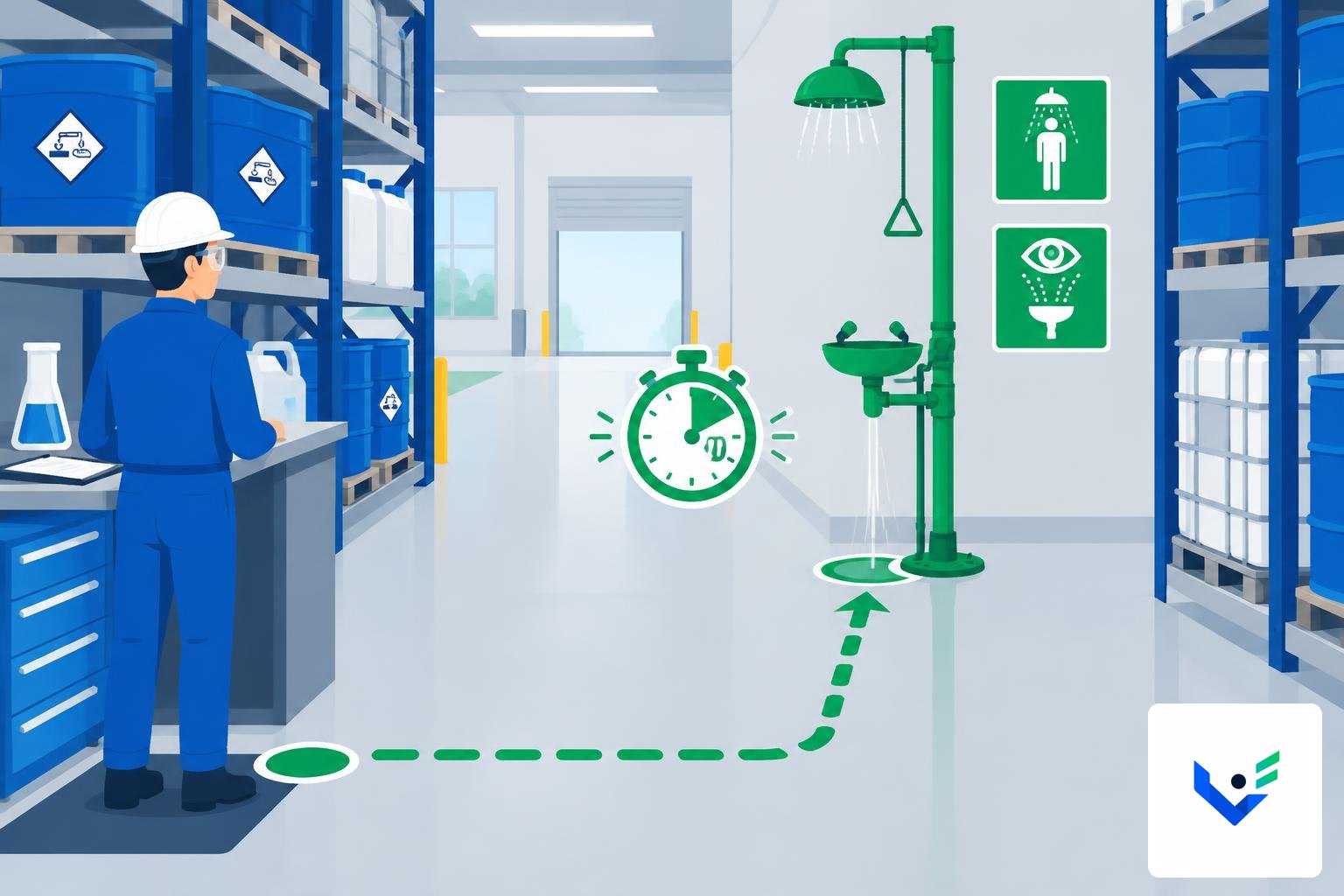
Emergency station layout: route from the workstation to the shower and eyewash, stopwatch and safety signs — VIMS EHS illustration
Illustrative image: a short, clear route and signage for the emergency shower.

3. Water and flow: what the regulation says and what EN 15154 adds

Short answer: the regulation only says showers should be supplied with unheated water and work reliably regardless of weather (§ 103(2)), so they do not depend on a boiler. Outdoor units need freeze protection.

EN 15154 covers plumbed body showers (part 1), plumbed eyewash units (part 2) and non-plumbed units (parts 3 and 4), including minimum flow and spray pattern. Catalogue values are often around 60 l/min for body showers and 6 l/min for eyewash units; check the current edition and manufacturer data.

Medical guidance and ANSI Z358.1 recommend tepid water (about 16–38°C) and rinsing for at least 15 minutes unless the SDS states otherwise. Tempered systems should be agreed with the installation designer so reliability is not compromised.

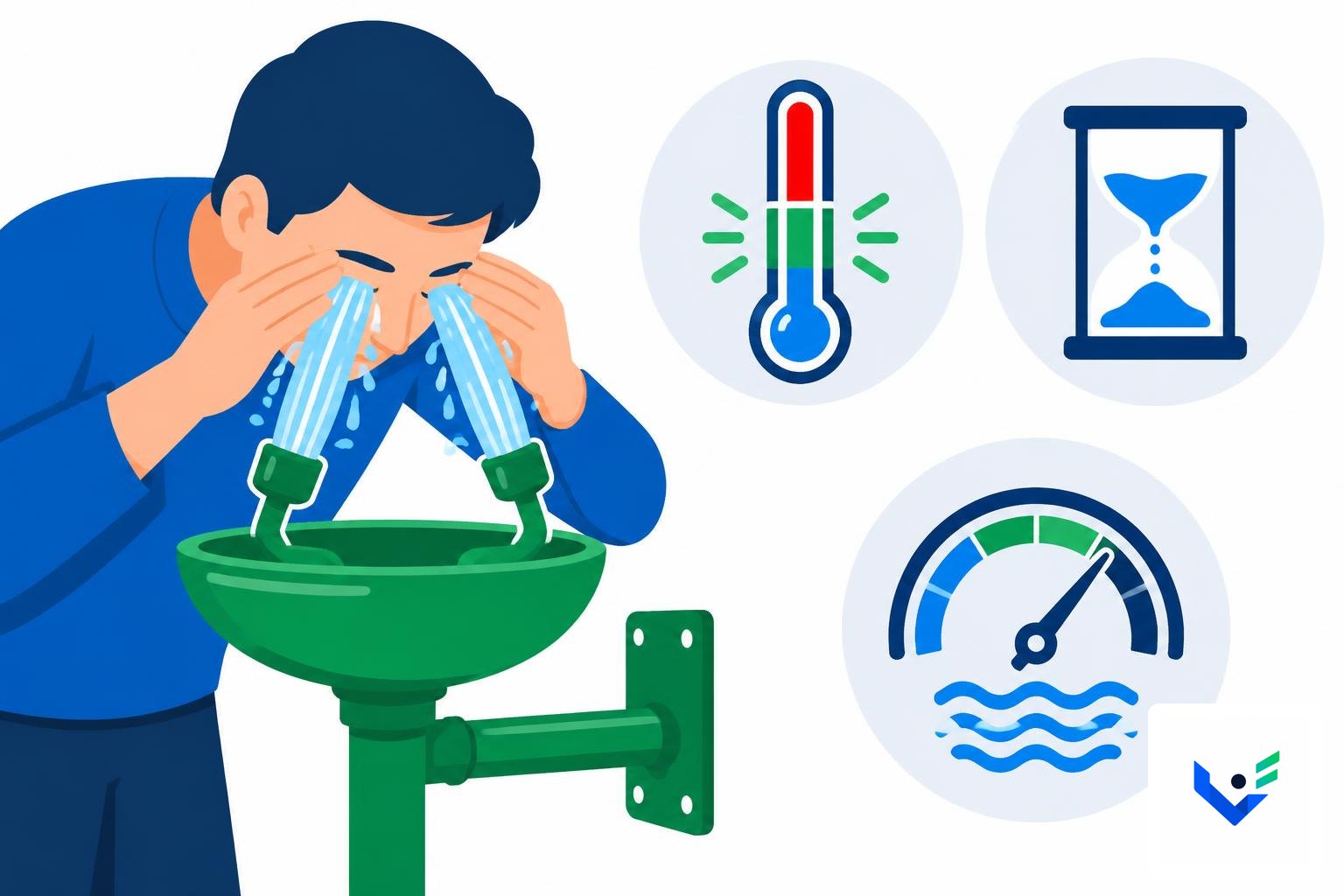
Worker rinsing eyes at an eyewash station with icons for water temperature, rinsing time and flow — VIMS EHS illustration
Illustrative image: temperature, rinsing time and flow are worth checking at commissioning and inspections.

4. How often should safety showers and eyewash stations be tested?

Short answer: Polish law sets no frequency; the unit simply has to work reliably. Good practice and ANSI Z358.1 recommend weekly activation and an annual inspection per the manufacturer.

The weekly flush clears sediment and limits bacterial growth such as Legionella. Check that the valve opens in one motion and stays open, dust covers are in place, the spray is even, drainage works and the route and signs are clear.

The annual inspection adds flow measurement, valves, seals and freeze protection, and whether the unit still matches the hazards after process changes.

5. Can a portable eyewash bottle replace a plumbed unit?

Short answer: no, where § 103 applies. Eyewash bottles (EN 15154-4) are supplementary — they let rinsing start immediately before the person reaches the fixed unit.

Bottles have limited volume and an expiry date, so track expiry, seal condition and location. Self-contained showers (EN 15154-3) need water replacement or treatment per the manufacturer.

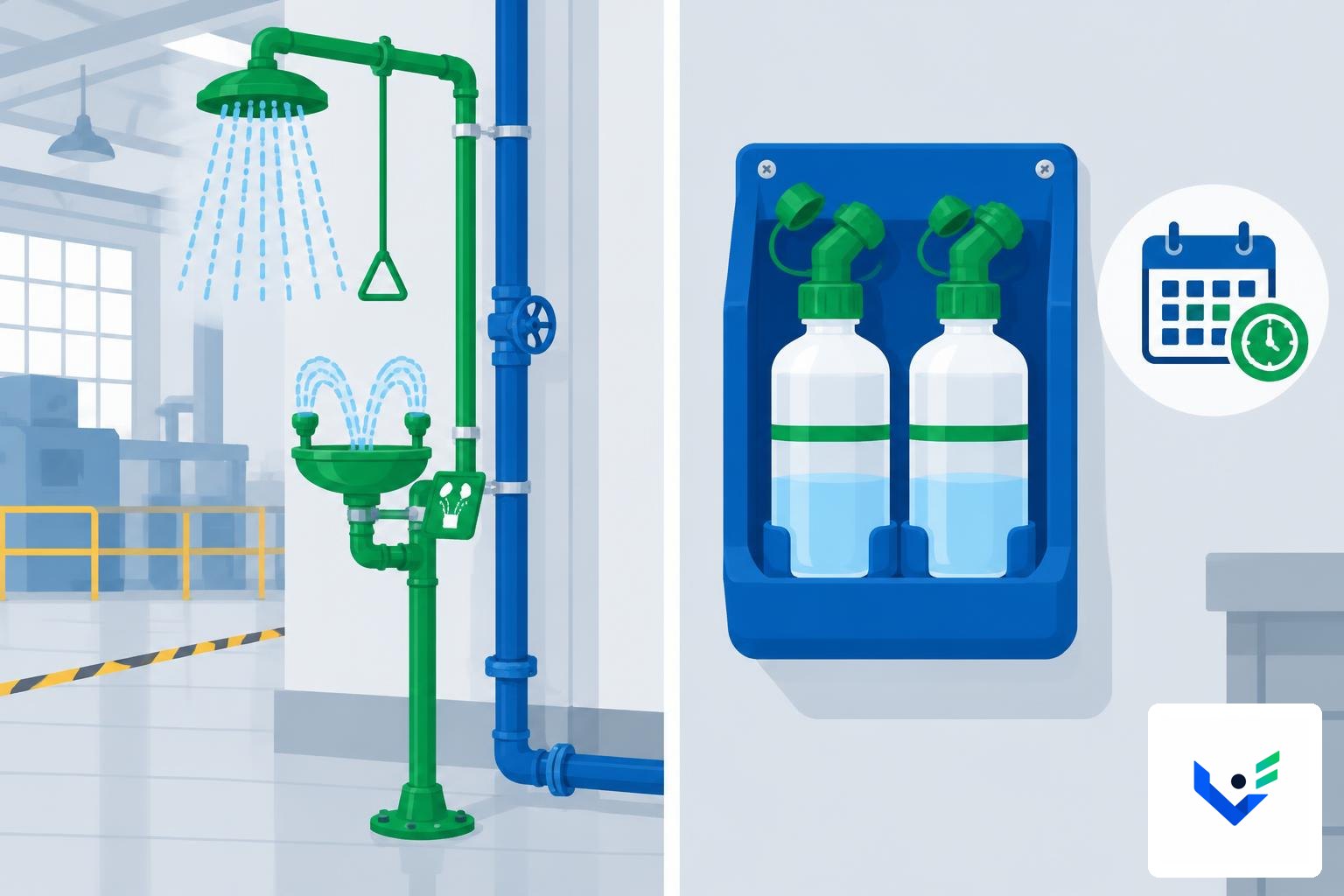
Plumbed emergency shower with eyewash compared with a wall station holding eyewash bottles with an expiry date — VIMS EHS illustration
Illustrative image: eyewash bottles supplement but do not replace a plumbed unit.

6. How to keep flushing and inspection records in VIMS

Short answer: each shower and bottle station becomes an item in equipment registers and inspections with weekly tests, annual inspections and bottle expiry dates. A QR code on the unit opens a short checklist on the phone.

Missed tests trigger reminders; defects become hazard reports with a due date. Units can be linked to the chemical register and site map. Try VIMS through our contact page.

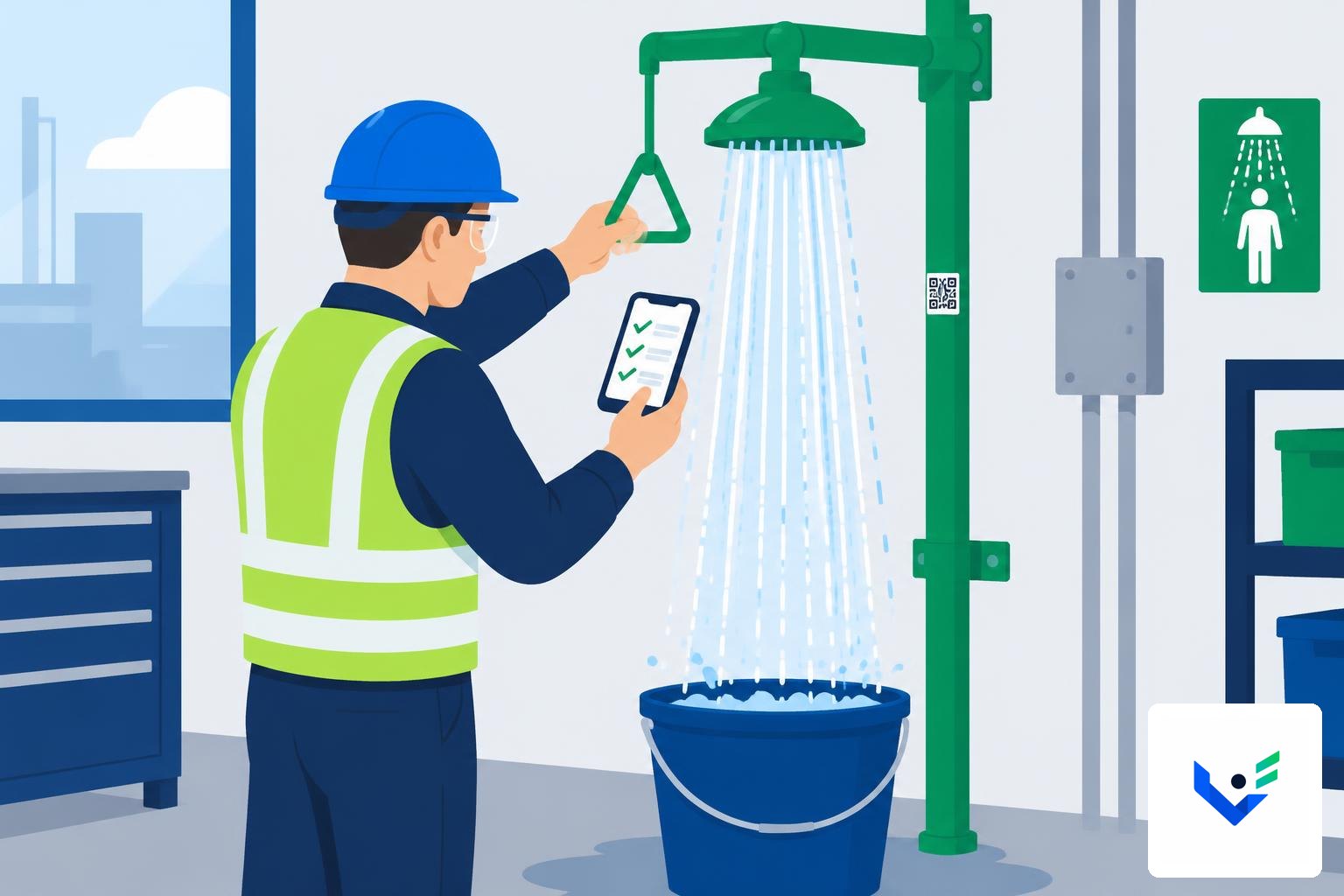
Maintenance worker running a weekly emergency shower test and scanning a QR code with a phone checklist — VIMS EHS illustration
Illustrative image: a weekly shower test confirmed on a phone after scanning a QR code. Not an app screenshot.

Legal requirements vs standards and manufacturer guidance

Polish legal duties separated from good practice. Details depend on the risk assessment, the standard and manufacturer documentation.

TopicRegulation (§ 103, Polish general OSH regulation)Standard or good practice
When requiredRisk of corrosive splash or clothing fireAlso where the SDS calls for immediate rinsing
EquipmentBody shower and separate eyewashEN 15154-1 and -2; parts 3 and 4 as supplements
DistanceMax 20 m horizontallyReachable in about 10 s (ANSI Z358.1)
ActivationImmediate, allowing for reduced abilityOne-motion, stay-open valve
WaterUnheated, reliable in any weatherTepid water, rinse about 15 minutes
TestingNo frequency setWeekly flush, annual inspection
Signage—ISO 7010 E012 and E011

Emergency shower and eyewash checklist

  • Risk assessment and SDSs identify workstations needing showers and eyewash.
  • Each has a body shower and a separate eyewash within 20 m.
  • The route is clear, lit and marked with E012 and E011.
  • Units activate in one motion.
  • Outdoor units are freeze-protected.
  • Weekly tests and annual inspections are scheduled and recorded.
  • Eyewash bottles have tracked expiry dates and intact seals.

Frequently asked questions about emergency showers and eyewash stations

When is an emergency shower mandatory in Poland?

When there is a risk of workers being splashed with corrosive substances or clothing catching fire — § 103 of the general OSH regulation.

How far from the workstation may it be?

No more than 20 m horizontally. Good practice also aims for about 10 seconds to reach it without obstacles.

How often should a safety shower be tested?

Polish law sets no frequency. Good practice is a weekly flush and an annual inspection per the manufacturer.

What water temperature is recommended?

The regulation requires unheated, reliable supply. Guidance recommends tepid water, about 16–38°C.

Does an eyewash bottle replace an eyewash station?

No. Bottles under EN 15154-4 are supplementary and have an expiry date to track.

Shower tests and inspections in one register

See how VIMS schedules weekly tests, annual inspections and bottle expiry dates and turns defects into tracked reports.